
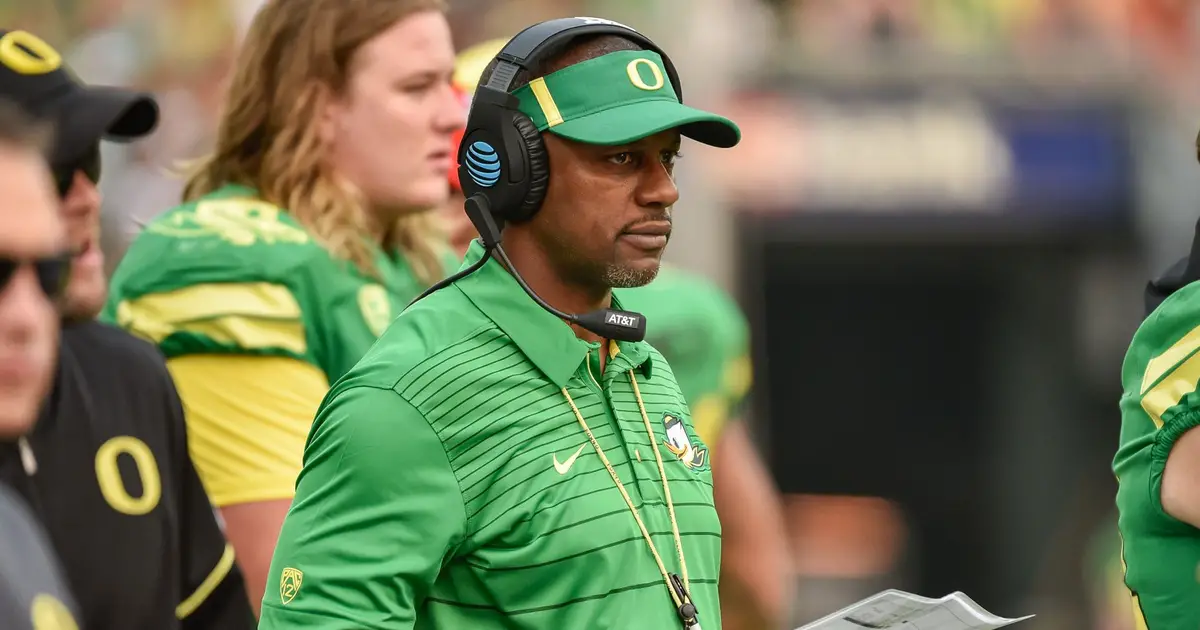
The Mark Helfrich era came to an abrupt end at the conclusion of the 2016 season. Athletic Director Rob Mullens quickly turned around and hired a young up-and-coming head coach from the University of South Florida, Willie Taggart. Taggart had an overall losing record prior to coming to Eugene, but that was less important than the signs of program improvement.
He coached at Western Kentucky where he spent three seasons as head coach, from 2010-2012. He went 2-10, 7-5, and 7-5 before moving on to South Florida. Because of some strong feelings about the this coach, Mr. FishDuck took a break from his fun at big banker free play to share his thoughts about Coach Taggart.
In his four seasons at South Florida things continued in a similar fashion as he went 2-10, 4-8, 8-5 and 10-2 (which was the first time the program recorded a double-digit-win season). Programs improved as he was an aggressive recruiter, something Oregon needed in the changing climate of college football.
It seemed clear that Taggart was the man to bring Oregon back to prominence.
New Faces
The first thing Taggart did upon arriving at Oregon was fire the entire Oregon staff. This was a bit of a shock to the fanbase as we loved our long-tenured coaches and believed them to be vital to our success. The reality is that the oldest coaches were quickly nearing retirement and their recruiting methods were becoming more dated by the year. Under Helfrich the Ducks did not use social media or texting as much as other younger programs.
Perhaps the two most consequential coaches brought into the program were Co-Offensive Coordinator Mario Cristobal and Defensive Coordinator Jim Leavitt. This new look Oregon football staff salvaged the 2017 Oregon recruiting class, which was in turmoil after the firing of the entire coaching staff. The 2017 class finished with a Rivals ranking of 18th in the country.
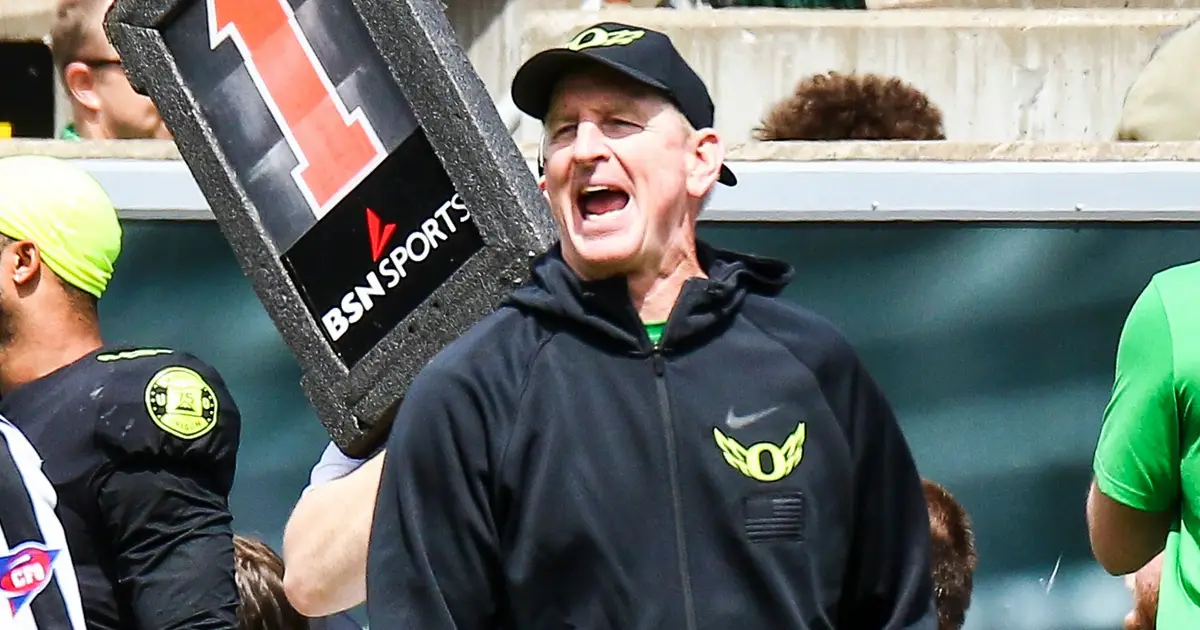
Jim Leavitt on the sideline during the Oregon 2017 Spring Game.
(Photo By: Gary Breedlove)
However, it is worth noting that the vast majority of the class was still composed of players recruited by Helfrich and the old staff, which makes sense as Taggart was brought in just before letters of intent were filed by players. Some of these Helfrich-recruited players were CJ Verdell, Alex Forsyth and Deommodore Lenoir. Taggart did leverage his Florida connections and the biggest impact recruit he added to the Oregon football roster was three-star Jordon Scott.
Though Taggart and company were able to convince Thomas Graham to come to Oregon, he was on the fence with the program as a new staff brought so much uncertainty — but they won him over. The same was partially true with Lenoir as he committed with the previous staff but was nervous about this new group.
This became the only class Taggart brought to Oregon.
The Rebuild
Taggart declared the Ducks’ program to be a complete rebuild. He already pushed out the old coaching staff and never made much of an effort to thank them for their long service and legacy to the institution. He didn’t need to do that, but instead by declaring the program weak and in need of a complete rebuild, it left fans feeling their program was disrespected.
Taggart also brought his own offense but instead of integrating it into Oregon’s culture, he kept his own name for it: the Gulf Coast Offense. It was an up-tempo Spread Offense, it wasn’t too different from the Oregon Blur, but in renaming the Oregon offense to something from the other coast that had no real connection to the state or program felt strange.
He also did away with the beloved Oregon slogan of “Win the Day” which was again, absolutely his right to do; however, he replaced it with what sounded like a Nike knockoff “Do Something” (more like a plea than an inspirational call to action).
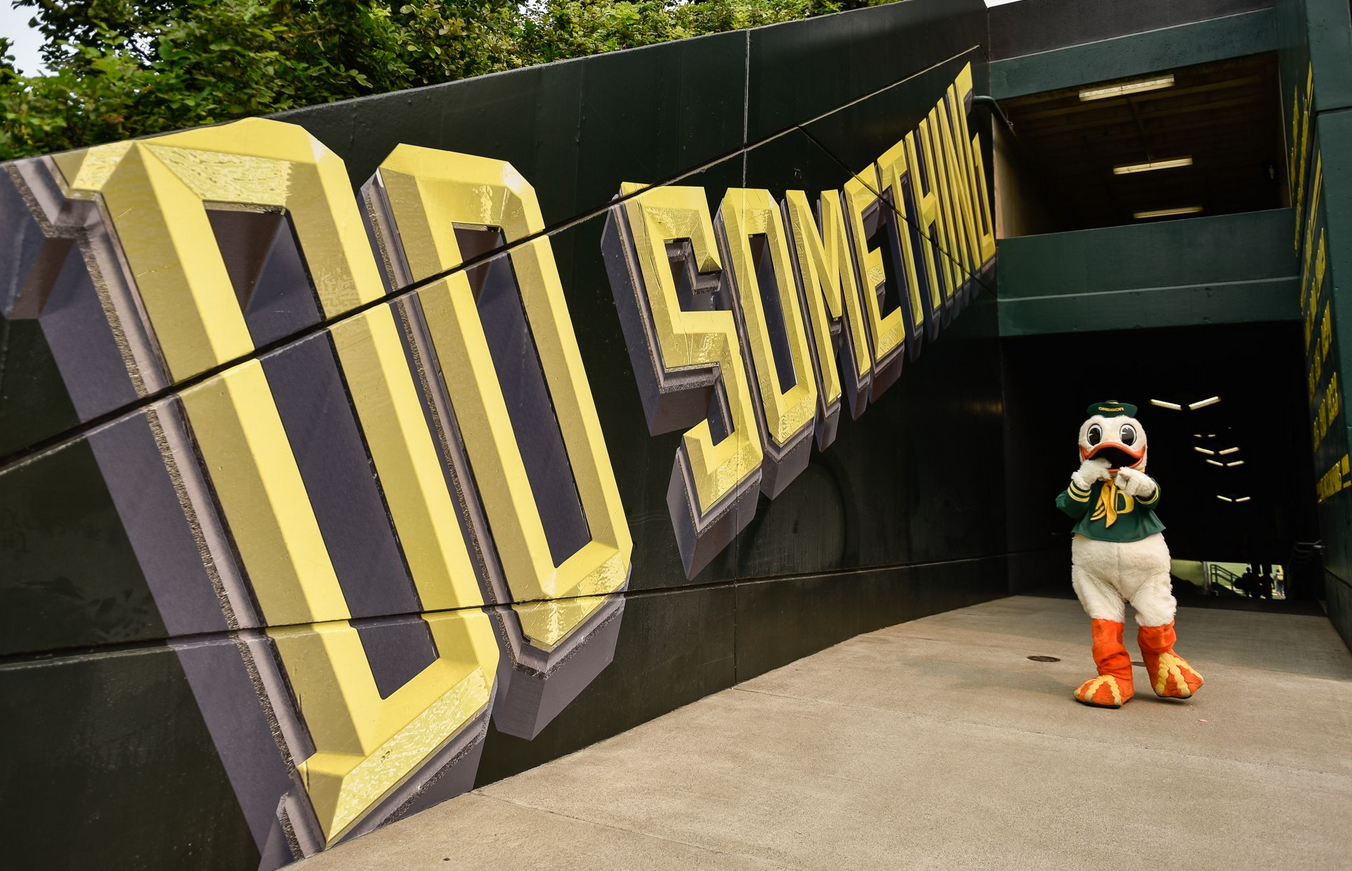
“Do Something” became the slogan of the Willie Taggart era at Oregon.
(Photo By: Kevin Cline)
This all felt like the Oregon Ducks were in the middle of an identity crisis as the new management didn’t seem to show any regard for Oregon’s past or any interest in learning about it.
But those were just the fan’s problems. The players had something much more difficult to overcome, the program’s culture changed and the mentality of strength and conditioning changed as well. Taggart dismissed long time Oregon football, and general athletics, coach Jim Radcliffe, Coach Rad, and replaced him with a full time football coach who was more interested in strength than speed, Irele Oderinde.
Oderinde imposed the winter workouts on the Oregon football team that tried to weed out the weaklings. Taggart had determined the players he deemed unworthy of playing for the Ducks and wanted to push them out of the program if they were unable to keep up with the intense off-season workouts. Oderinde put players through long and exhausting workouts that outright overworked many players. Three players were hospitalized for the malpractice of these conditioning drills.
This was an embarrassment out the gate for the Taggart era.
The 2017 Season
The 2017 season was an improvement over 2016, though wasn’t difficult to do as the Ducks bottomed out in 2016 with an awful defensive coordinator in Brady Hoke and a roster that was highly dependent on first-year starters. 2017 was going to be a better season with just two major changes. One, those first-year starters were now in Year 2 and improved greatly. And secondly, Leavitt was a far better defensive coordinator than Hoke.
However, the Ducks still finished the regular season at 7-5 and that was largely due to starting quarterback Justin Herbert going down with a broken collarbone in a touchdown run against Cal.
The Ducks were forced to wait six long and agonizing weeks for Herbert to recover as fans watched the Ducks lose to Washington, Washington State, UCLA and Stanford in embarrassing fashion as Braxton Burmeister was woefully incapable of running the offense.
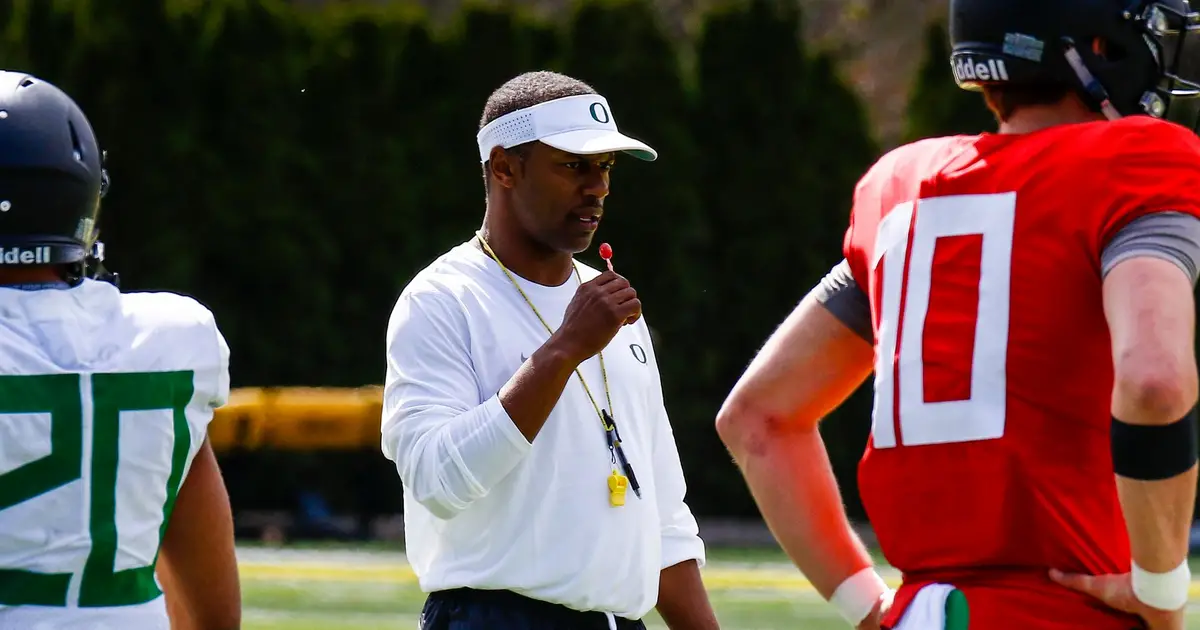
Willie Taggart and his lollipop while supervising practice.
(Photo By: Gary Breedlove)
The Ducks survived the season and were going to the Las Vegas Bowl in mid-December for a match-up against Boise State. Only, Taggart wasn’t going to join the team as he took the newly-open job at Florida State as soon as the season ended. Taggart was gone in a little under a year.
Did Oregon Need a Rebuild?
Oregon probably did not need a full rebuild as was advertised by Taggart.
Herbert is an incredible player who had a way of making any head coach look good, and his second year of college football saw him make additional development (his will be a trend in the next article in this series looking at the Cristobal era). The reality is that Herbert’s production between the two season was remarkably similar — he threw for just over 1,900 yards had 19 passing touchdowns in 2016 whereas he only had 15 in 2017 and his rushing yards were in negligible, though he did run for three more touchdowns in 2017 (5) than in 2016 (2).
The offense on the whole averaged the same number of points between 2016 and 2017 as well. The Gulf Coast Offense Taggart brought in was more dependent on the running game than Helfrich’s offense in 2016, but that was in large part due to an injured Herbert and not having a suitable backup quarterback.
The side of the ball that needed help was defense; the biggest problem with the offense in 2016 was that it never had the ball because the defense never got off the field. Taggart’s new defensive coordinator Leavitt came to Oregon and changed the scheme and elevated the play calling from the previous year. The defense had a massive turnaround between 2016 and 2017 where the defense only gave up 29 points per game, a massive decrease from the 41 points per game the Ducks surrendered in 2016.
However, outside of a few freshman who would develop into key contributors in future years, this was mostly done on the backs of veterans from the 2016 team. Scheme matters, and a change in scheme and defensive coordinator was what Oregon needed. Oregon probably did not need a rebuild, it needed a defensive schematic overhaul. The offense was fine.
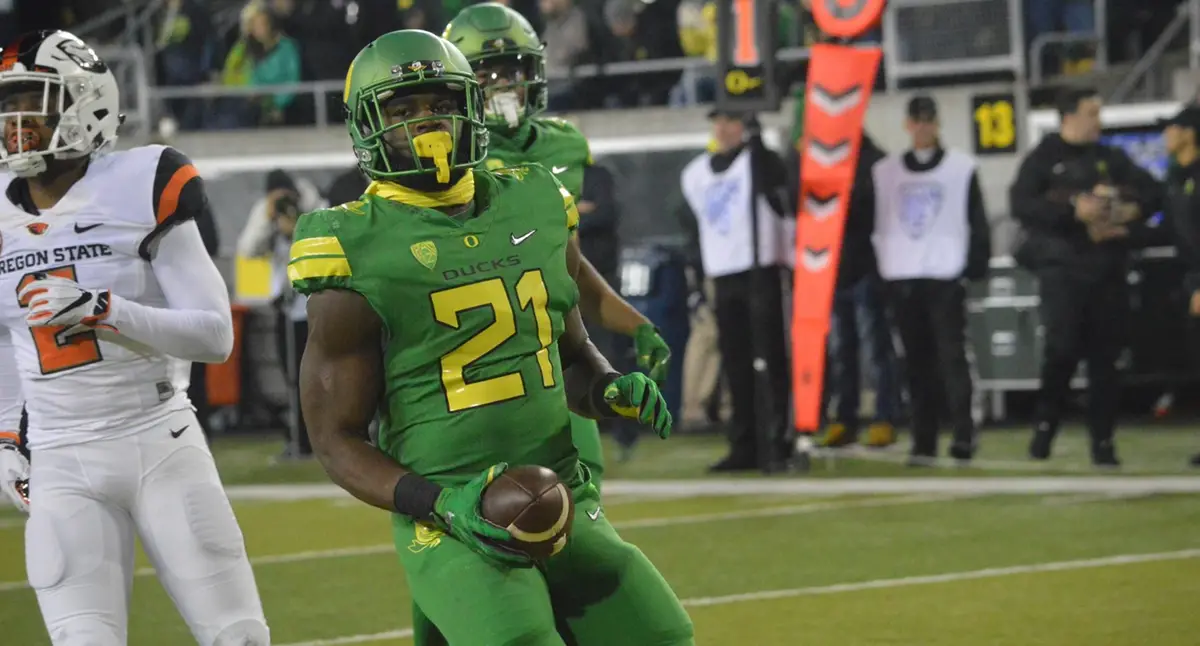
Royce Freeman continued to roll with Taggart as Head Coach.
(Photo By: Jerry Thompson)
The Abrupt End
Taggart left Oregon on December 5, 2017 and took the Florida State job. At the time it felt like an absolute shock to fans as he wasn’t even Oregon’s head coach for a full year, and the recruiting class he was putting together fell to pieces as he poached half of his coaching staff and plundered Oregon’s verbal commits to bring them to FSU with him.
In hindsight though, it never felt like Taggart was truly committed to Oregon. His family remained in Florida while he coached at Oregon for the year. He also had a track record of jumping from his current team to a new one before bowl season, though each time it felt like he was just taking the next step in his career. Taggart gave Oregon fans a taste of something we really hadn’t felt before, being a stepping stone program. We weren’t Taggart’s dream job, we were the means to get him to his dream job, a Florida school. If he was at Oregon for four years and then took a Florida job, that would be one thing, but he was only at Oregon for a year before running.
In the end it was Taggart’s dismantling of Oregon’s recruiting class that hurt. The loss to Boise State in the Vegas Bowl absolutely rubbed salt in the wound as then interim head coach Cristobal was desperately scrambling to salvage his recruiting class because the early signing period was around the same time as the bowl game. The team was in disarray, but stocking the roster with future recruits took priority over a bowl game.
Perhaps the biggest and most positive thing to come out of the incredibly short Taggart era was how he revealed that Oregon could be a recruiting powerhouse with its brand and the right head coach. This opened the door for Cristobal to make his impact on the program.
David Marsh
Portland, Oregon
Top Photo By: Kevin Cline
Other Articles in this Series
How should Ducks Fans Remember Chip Kelly?
How Should Ducks Fans Remember Mark Helfrich?

Natalie Liebhaber, the FishDuck.com Volunteer Editor for this article, works in technology in SLC, Utah.
Share your thoughts about this team in the only free, “polite and respectful” Oregon Sports message board, the Our Beloved Ducks forum!
Related Articles:

David Marsh is a high school social studies teacher in Portland, Oregon. As a teacher he is known for telling puns to his students who sometimes laugh out of sympathy, and being both eccentric about history and the Ducks.
David graduated from the University of Oregon in 2012 with Majors in: Medieval Studies, Religious Studies, and Geography. David began following Ducks Football after being in a car accident in 2012; finding football something new and exciting to learn about during this difficult time in his life. Now, he cannot see life without Oregon football.