
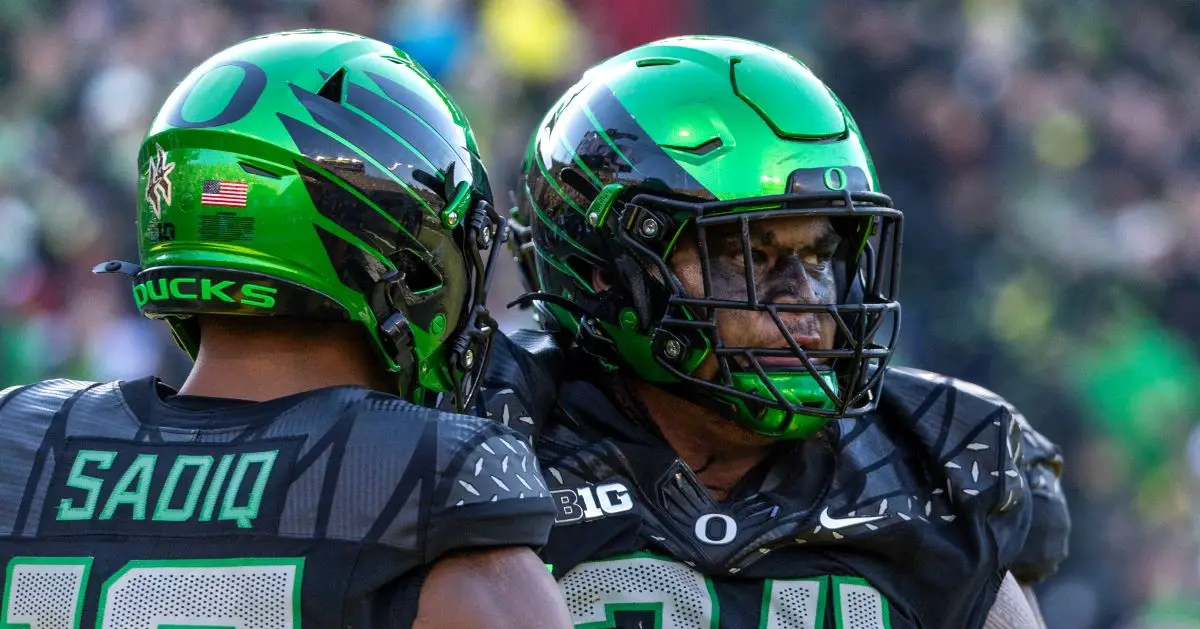
For all of the noise around rankings, résumés and selection-committee math, Oregon’s path is brutally simple: win in Seattle, and the Ducks are almost certainly in the College Football Playoff. Lose, and everything gets complicated fast.
Standing in their way is their oldest, bitterest rival — a loose federation of purplish-colored organisms that fear loud noises, react poorly to daylight, and speak in distressed grunts whilst pawing through spent grain at the Montlake slop trough.
No. 6 Oregon (10-1, 7-1 Big Ten) visits Washington (8-3, 5-3) on Saturday at Husky Stadium in the 118th meeting of a series that has swung hard in the Ducks’ favor in recent decades but is still led overall by the Huskies, 63-49-5. Mr. FishDuck had to take a break from his fun at Non GamStop Casinos to vent to me about his long-simmering issues with the NW Dawgs.
Kickoff is 12:30 p.m. Pacific on CBS at one of college football’s loudest venues, where the Ducks haven’t won since 2021 and where two fan bases that “don’t like each other,” as Oregon coach Dan Lanning put it, will have plenty on the line.
Side note: Listening to some Dawg-casts this past week, it’s finally become clear why many of the knuckle-dragging, mouth-breathing, booger-eating Husky faithful despise the Ducks: Phil Knight. They actually believe Oregon hasn’t earned its spot in the national landscape, arguing that Uncle Phil wrote a check to bypass decades of program-building — as if Don James was a paragon of honest recruiting, remembered for his piety and monastic virtue. (Insert fart sound here.) The position is, of course, sad and marvelously absurd, especially when voiced by a fanbase whose family trees rarely branch.
A CFP berth, Big Ten title hopes, and a year’s worth of bragging rights will be decided in a matchup that pits Oregon’s explosive, balanced offense against a retooled Washington defense and a dual-threat Husky quarterback who already knows what it’s like to be sacked 10 times by the Ducks.
Oregon enters with the nation’s longest active road winning streak at 11 games and a statistical profile usually reserved for title contenders. The Ducks rank 12th nationally in total offense (471.8 yards per game) and eighth in scoring (39.3 points) while boasting the No. 3 total defense (248.7), No. 3 passing defense (145.7) and a top-15 rushing defense.
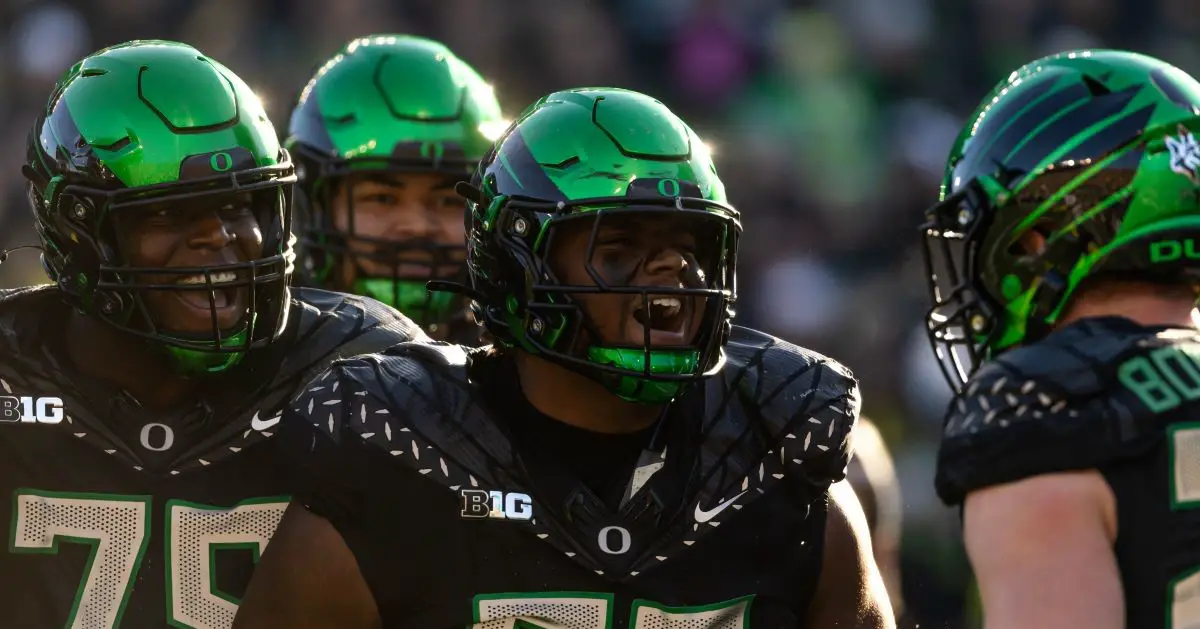
Oregon’s offensive line laughing all the way to the bank during a touchdown celebration against USC last weekend in Eugene. Photo by Max Unkrich
ESPN’s playoff predictor gives Oregon better than a 90% chance to make the expanded 12-team CFP field, and some models project the Ducks as a near-lock with a win. A loss likely drops them into the 9-12 seed range and a road game in the first round (The same route reigning champs Ohio State took last year) or out of the bracket entirely.
The conference picture is slightly murkier. If Oregon wins and No. 1 Ohio State loses at No. 18 Michigan earlier Saturday, the Ducks will advance to the Big Ten Championship game for the second straight season. Plenty of Ducks fans emphatically dislike this scenario, for the mere thought of reliving last year’s Rose Bowl sends a sharp, metallic pang clean through the skull — not unlike the sensation one might enjoy if an errant carpenter’s nail were to lodge itself, with pioneer enthusiasm, in the side of one’s head.
Washington, out of the playoff race after losses to Ohio State, Michigan and Wisconsin, can still reach 9-3 and improve its bowl destination — and perhaps more importantly to Huskies fans, derail Oregon’s postseason run.
In Washington head coach Jedd Fisch’s office, there is a “Beat Oregon Today” etched into the wall next to an Adidas logo, a laughable nod to how much this game still means in Seattle. Nice sign, Jedd.
Washington’s historical edge is built largely on dominance in the horse-and-buggy days before 1980 (and about as memorable as Captain & Tennille’s “Do That to Me One More Time”), when 43 of the Huskies’ wins were already in the books. Since then, the series has tilted toward Oregon, highlighted by a 49-21 Oregon romp at Autzen Stadium last season in the first Big Ten meeting between the schools.
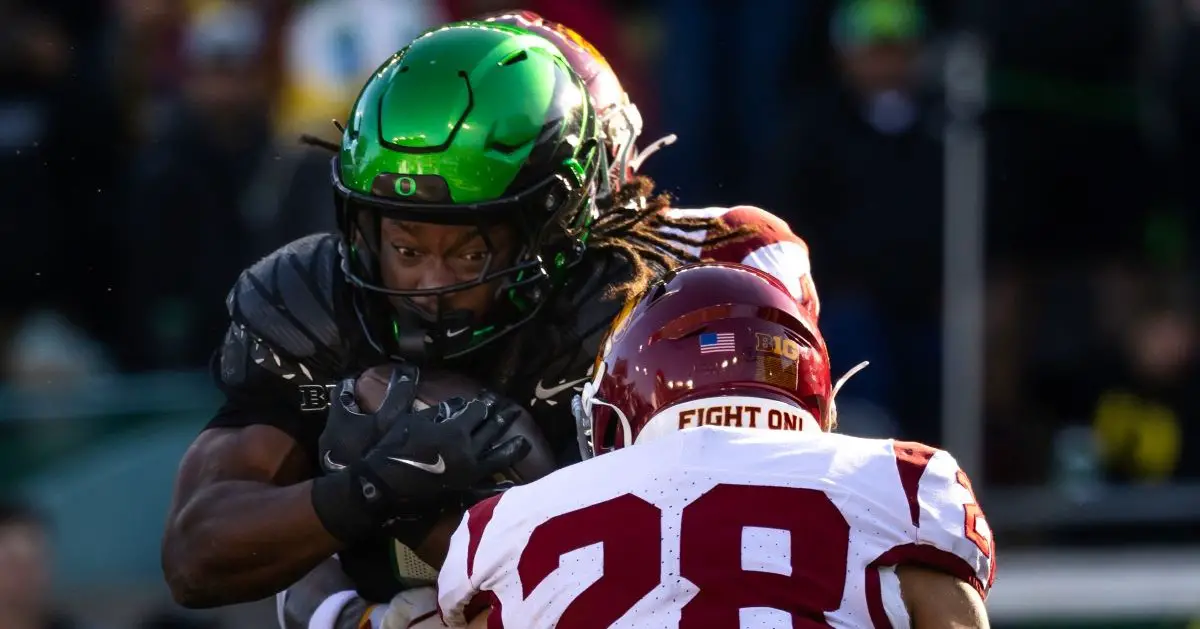
Oregon’s leading rusher, Noah Whittington, powers through Trojan defenders during the Ducks’ 42-27 victory last Saturday over USC. Photo by Max Unkrich
That 2024 victory was cathartic in Eugene. In last year’s win, Oregon sacked Washington quarterback Demond Williams Jr. 10 times and held the Huskies to 43 rushing yards while piling up 222 on the ground. Since then, the hatred hasn’t cooled in either city.
Oregon vs. Washington
If this game turns on Oregon’s offense, the Ducks have reason to like their chances. Quarterback Dante Moore, a transfer who has blossomed into one of the nation’s most efficient passers, has thrown for 2,447 yards and 23 touchdowns with six interceptions while completing 72.9% of his passes.
Tight end Kenyon Sadiq (479 yards, 8 TDs), hewn from quarried stone, has emerged as Moore’s favorite red-zone target, while Oregon’s run game — powered by Western Kentucky transfer Noah Whittington (727 yards, 6 TDs), Mater Dei alum and true freshman Jordon Davison (511 yards, 13 TDs) and Belleville’s brightest, Dierre Hill Jr. (452 yards, 4 TDs) — ranks eighth nationally at 228.6 yards per game and third in yards per carry (6.13).
The Ducks’ offense leads the nation in plays of 20-plus yards and their third-down offense has also been elite, converting exactly 50% of its attempts, ninth in the FBS.
But this is not the same Washington defense Oregon shredded a year ago.
After last season, Fisch hired former Purdue head coach and Illinois defensive coordinator Ryan Walters to overhaul a unit that struggled in 2024. The result: the Huskies enter ranked 18th nationally in total defense (304 yards per game), 17th against the run (103.5 yards per game) and 19th in scoring defense (18.8 points per game).
Washington’s defense has allowed only two opponents to surpass 300 yards all season: Ohio State, which racked up 357 yards in a 24-6 win, and Rutgers, which had 493 in a 38-19 loss.
For the Ducks, the offensive line was shuffled repeatedly during last week’s 42-27 win over USC. Starting center Iapani “Poncho” Laloulu left in the first quarter with a foot injury and did not return; Lanning called his status “we’ll see” for Washington. However, veteran walk-on Charlie Pickard filled in at center and quickly drew praise.
Starting tackles Isaiah World and Alex Harkey also battled leg injuries against USC, leading to extended snaps for redshirt freshman Fox Crader and backup Kawika Rogers.
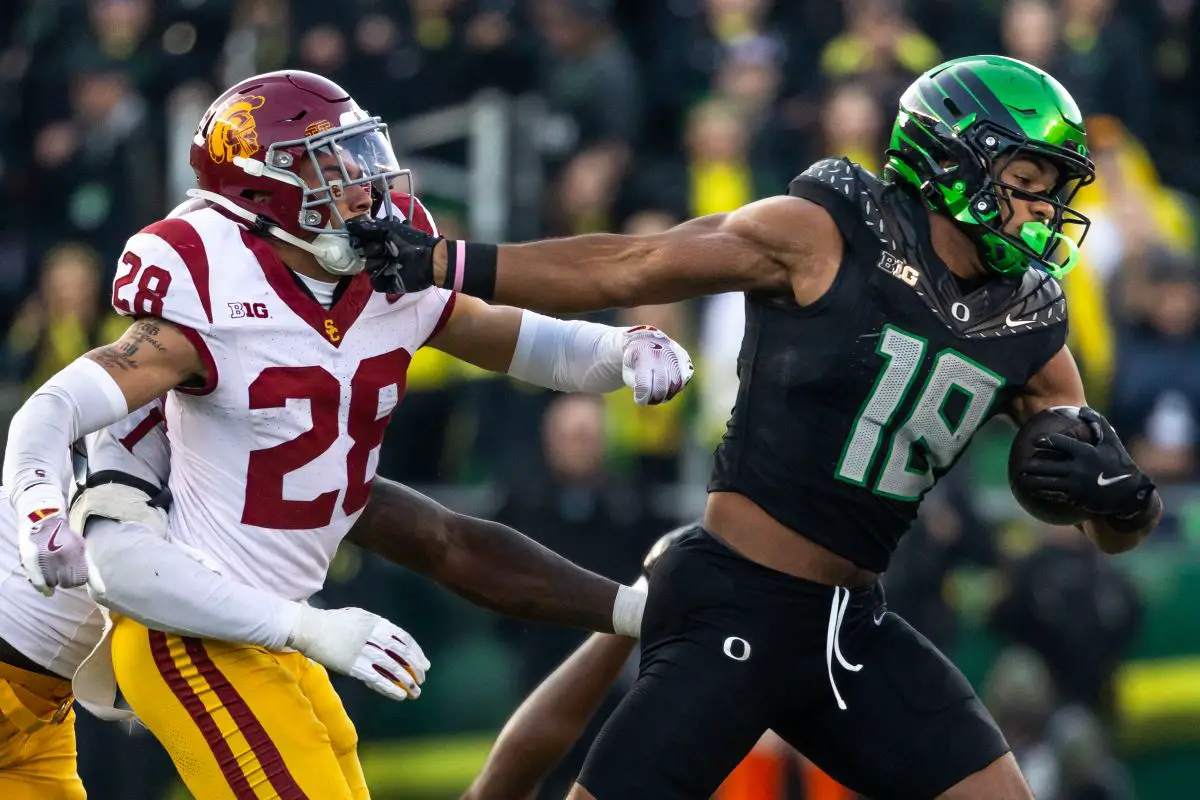
Oregon tight end Kenyon Sadiq gives a stiff arm to a USC defender en route to the end zone last Saturday in Eugene. Photo by Max Unkrich
One key stat: Oregon is 24th nationally with a plus-6 turnover margin, while Washington’s defense has been ordinary on third down, allowing opponents to convert 39% of the time (67th).
If Oregon’s offense is the headliner, Washington’s attack is the wildcard. Williams Jr. has quietly been one of the Big Ten’s more efficient players, throwing for 2,721 yards and 19 touchdowns with six interceptions on 72% passing while adding 568 rushing yards and six scores.
Running back Jonah Coleman, who followed Fisch from Arizona, has battled a knee injury but still has 651 rushing yards and 14 touchdowns.
Top receiver Denzel Boston (52 catches, 730 yards, 8 TDs) has also been limited by an ankle injury but is expected to have a larger role against Oregon. Washington averages 426.5 yards and 35.5 points per game, ranking 30th and 19th in the FBS.
Oregon counters with one of the nation’s stingiest defenses. The Ducks allow just 14.9 points per game and have held opponents under 300 yards in eight of 11 contests.
Defensive coordinator Tosh Lupoi’s group is particularly tough against the pass, giving up 145.7 yards per game and thriving on disguised coverages and pressure from edge rushers Teitum Tuioti (5.5 sacks) and Matayo Uiagalelei (5.0).
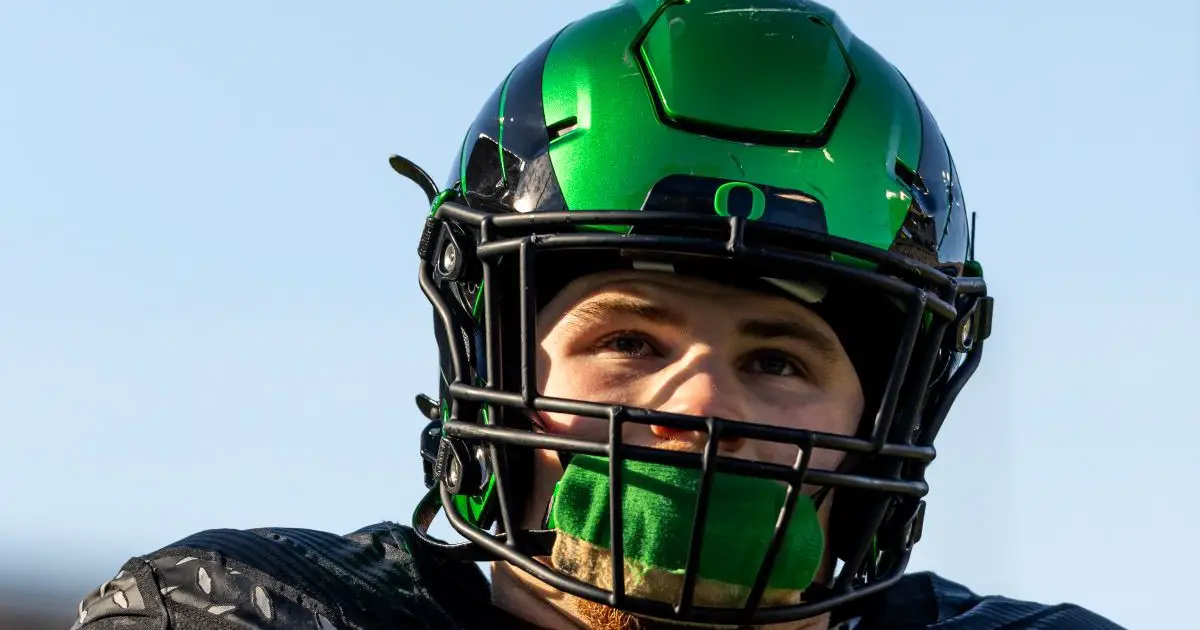
Ducks linebacker Bryce Boettcher will face the Huskies for the final time of his Oregon career this Saturday in Seattle. Photo by Max Unkrich
The Ducks’ most significant concern on Saturday is containing Williams’ scrambling.
Oregon’s pass defense also showed some vulnerability against USC, surrendering a season-high 330 passing yards and three touchdowns, but the Ducks also grabbed two interceptions and held the Trojans to 52 rushing yards. Most will take that every day of the week.
The bottom line
The Ducks possess the more complete team statistically, with a top-10 offense and defense, a more dominant run game, a healthier defensive front and a full head of steam. They’ve won 11 straight road games and have shown they can win shootouts and slugfests alike.
Lanning insists his players understand both the stakes and the need to treat it like any other game.
“I think when you play your best is whenever you’re able to level-set and realize, hey, there’s some emotions that exist,” Lanning told media outlets. “But ultimately, you win by executing like it is just another game.”
Just another game — with a playoff berth, conference title shot and 100-plus years of history riding on every snap. Go. Ducks.
Related Articles:

Jordan is a lifelong Duck fan currently living in San Diego. Jordan graduated from The Evergreen State College in Olympia, Washington, after serving a prestigious fellowship with the Washington State House of Representatives. Upon graduation, he worked as an English language teaching assistant for the Spanish Ministry of Education’s Ambassadorial Program in Monforte de Lemos, Spain. Jordan has worked as a journalist, writer, and editor in Oregon, Washington, Montana, and California, covering a wide range of topics, including sports, local politics, and crime. He is VERY excited to be writing about his beloved Oregon Ducks.