
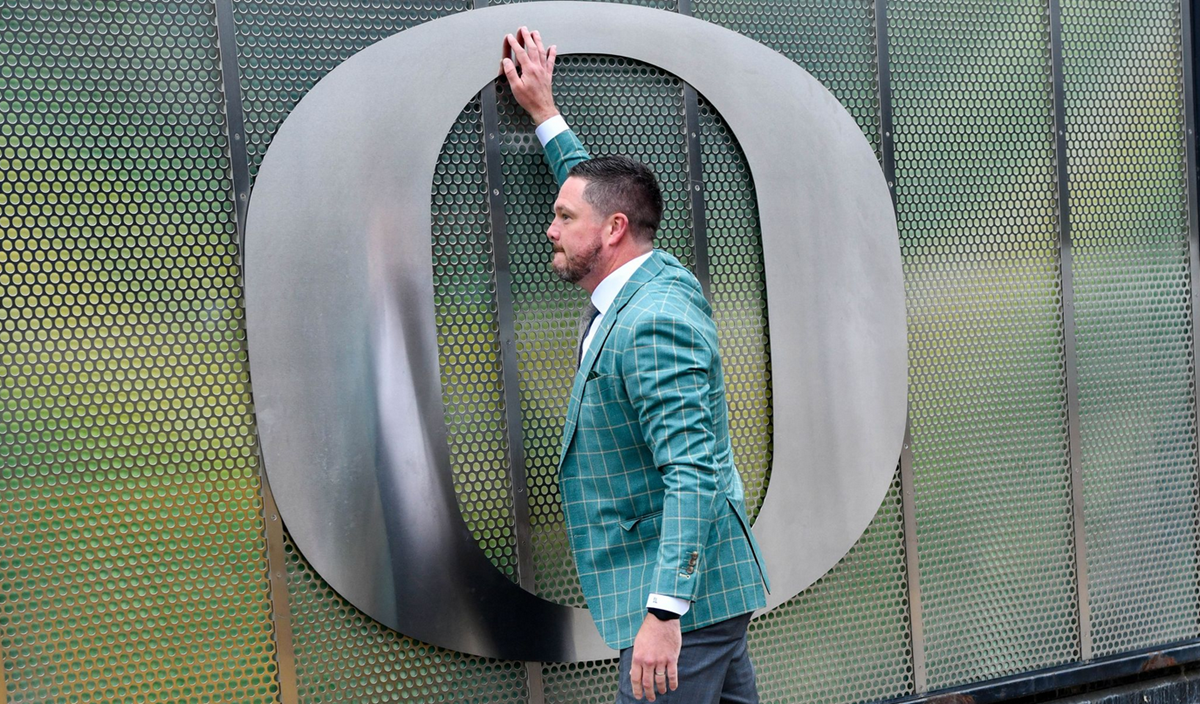
Oregon has just finished signing the third-ranked recruiting class in the 2026 cycle, according to Rivals. However, based on player average score, Oregon has the best average. The Ducks broke a record number of five-star recruits with five, and have just as many five-star recruits as they do three-stars. Even Mr. FishDuck paused from his investigation into quick money support in Oregon to marvel at the high quality 2025 Oregon recruiting class.
This didn’t happen overnight, but has been decades in the making — though some rules changes along the way have been to the Ducks’ benefit.
5. Uniforms
Beginning in the 2000s, Oregon and Nike started to experiment with uniforms. This partnership has created the foundation for Oregon and its recruiting. Perhaps the most fundamental aspect of marketing is finding a cool factor. Now, what is and isn’t cool is in the eye of the beholder or target audience, and in this case the target audience is teenagers. Oregon and Nike found something special to put the Ducks on the college football map. They were not only cool, but trendsetting.
Shiny chrome helmets? Started with Oregon.
Gloves with the school’s decal? Started with Oregon.
New weekly uniform combos? Started with Oregon and remains mostly an Oregon-only thing.
Black, not as a school color, alternative uniforms? Maybe didn’t start with Oregon, but certainly became popular because of Oregon.
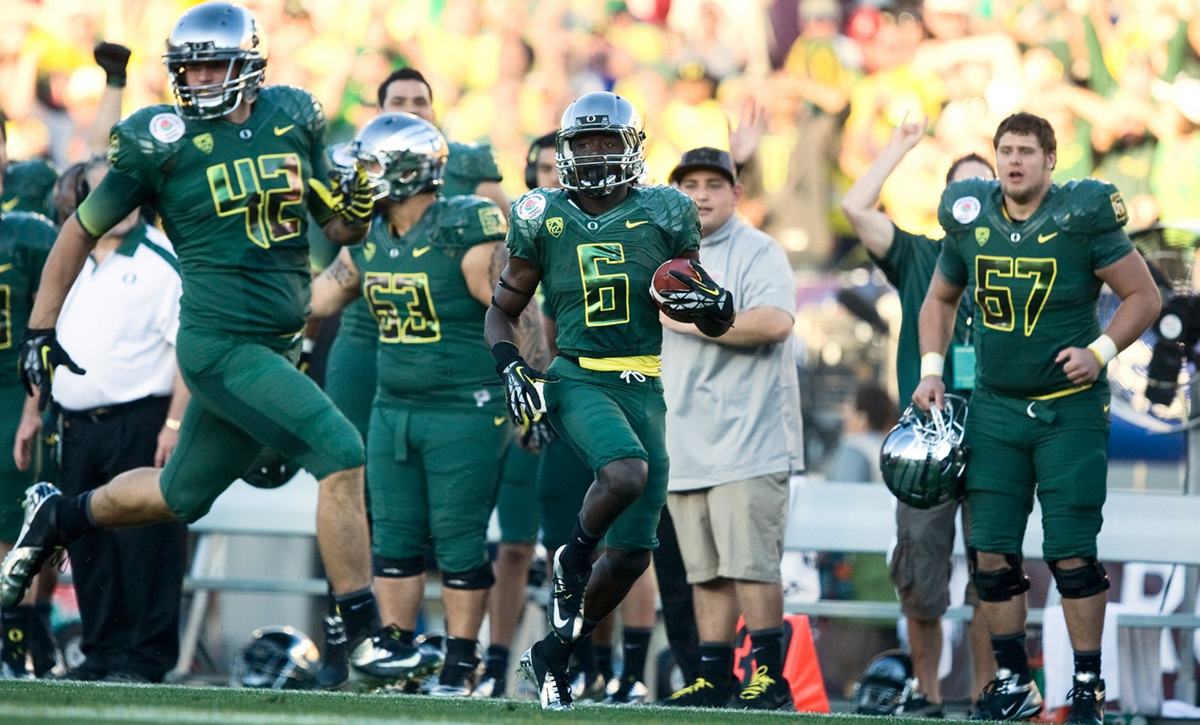
Who could forget the 2012 Rose Bowl when Oregon came out with chrome helmets for the first time!
(Photo By: Amazing Moments Photography)
Couple these new and innovative uniforms with an electric Chip Kelly offense, and you have a program that is in the minds of a generation of college football recruits. Today’s recruits may not remember the Kelly era, but know Oregon for its high-powered offense and uniform combos. After all, how many times have we all seen an interview with a prospective recruit who said that growing up, he was an Oregon fan?
That doesn’t mean Oregon is going to land all these recruits, but it does get the Ducks in the door, which is where recruiting starts.
4. Official Visits Increased
Official visits are college visits in which the college pays for the recruit’s flight and housing. Whereas, unofficial visits are paid for entirely by the recruit. Unofficial visits have given programs located in recruiting hotbeds a massive advantage because recruits can make multiple visits over the course of a season. Oregon’s geographic isolation from major recruiting hotbeds means the Ducks have always relied more upon getting recruits to campus via official visits.
These visits are opportunities for recruits to get special attention from the coaching staff and a tour of the facilities, and one of the biggest game-changers in Oregon’s growth as a national power has been (and continues to be) its facilities. Right now the Ducks are in the middle of construction of one of the more advanced practice facilities in the country.
But seeing pictures or videos of these marvels can only impress recruits so much; they need to see them to believe just how invested Oregon and its biggest booster Phil Knight are in Ducks football.
A decade ago the max official visits a program had was 56, just over double the 25 scholarship allotment for each year’s recruiting class. There was little wiggle room for Oregon to bring long-shot candidates to campus in the hopes they would fall in love with the program. Distance has always been a factor in recruiting, but its impact has lessened with the growth of NIL and the growing ease of flights into Eugene.
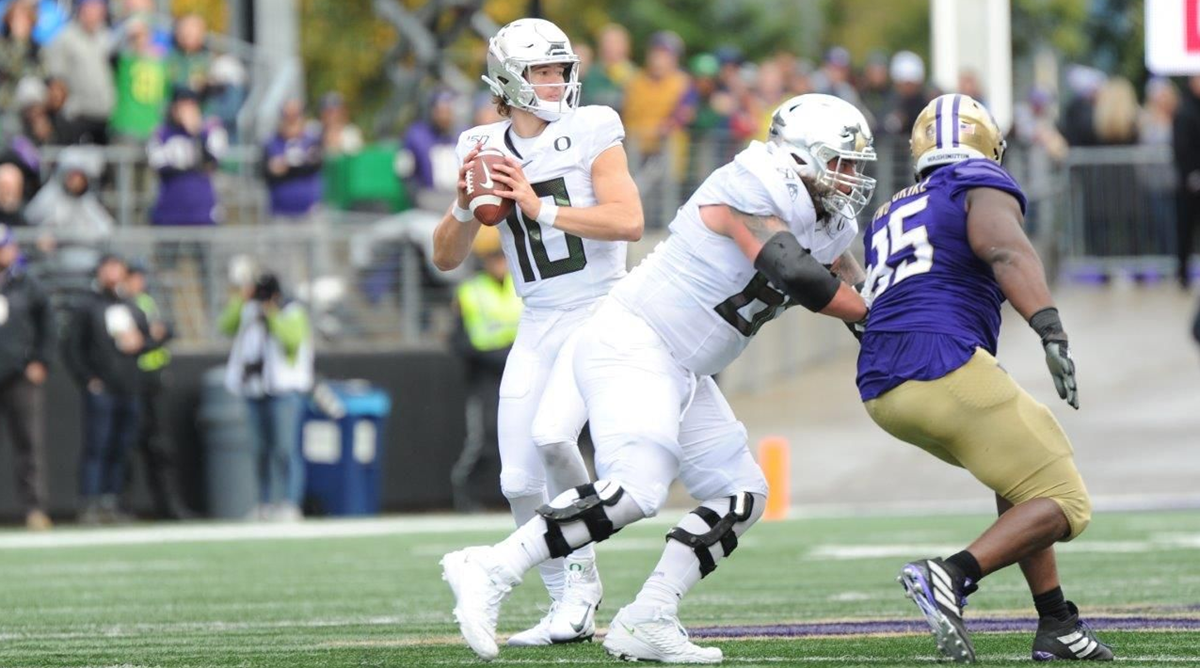
Justin Herbert was a Helfrich recruit partially out of the recruiting restrictions and Herbert being from Eugene. He was also an amazing player!
(Photo By: Tom Corno)
To make matters worse during the Mark Helfrich era, upon Kelly’s departure sanctions were placed on Oregon that reduced Oregon’s max scholarships by one per year — but the real hit to Oregon recruiting was the loss of official visits, which was reduced to 37. This hurt recruiting more than anything, as under Helfrich Oregon couldn’t just send out official visit invites to long-shots in the hope they were persuaded to come, but needed to focus on more realistic prospects.
Over the last three years, there have really been no limits on how many official visits a program is allowed to host, though it is still a max of one per player. This changed the recruiting game for Oregon, as Dan Lanning is able to get even vaguely interested prospects to campus and start to build a relationship. With Oregon’s facilities, seeing is believing, and being able to get players on to campus makes it a whole lot easier for them to envision themselves wearing green and yellow.
3. NIL
NIL has been touted as the great equalizer of college football. The reality is that between it and the transfer portal, it has changed how recruiting functions, and the blue blood dynasties don’t have as much recruiting power as they used to. This does not mean it is an equalizer, as many programs have floundered with the advent of NIL. Oregon, however, is one of the programs that has leveraged NIL into a massive game changer.
A quick note on NIL: it is not money a school is paying athletes. Direct payments to athletes is coming, but that will be because of the House Settlement and not NIL, which is payments coming from outside sources for the use of a player’s Name, Image, or Likeness for advertising purposes.
Oregon boasts one of the best, if not the best, NIL collective in Division Street. Division Street does not just provide slush funds to throw at athletes, but builds additional NIL opportunities for Oregon athletes. It also doesn’t hurt that there is a strong connection between Oregon and Nike, which paves the way for many athletes to have connections into the sportswear industry after their football careers conclude.
But Oregon and Division Street do not spend the most money in terms of NIL. Instead, NIL is used to ensure recruits take Oregon seriously and consider the Ducks. The reality is that pay for play is here and Oregon is willing to compete with the blue bloods for talent.
2. The Transfer Portal
The transfer portal has changed how recruiting functions for the entire sport. The portal itself can be a determent for recruiting prep athletes who believe they should play right away. This was the case when Dante Moore choose UCLA over Oregon coming out of high school. However, relationships built on the recruiting trail still have value, and if it doesn’t work out, a player may opt to transfer to one of the other schools that recruited him — just like Moore coming to Oregon after his year at UCLA.
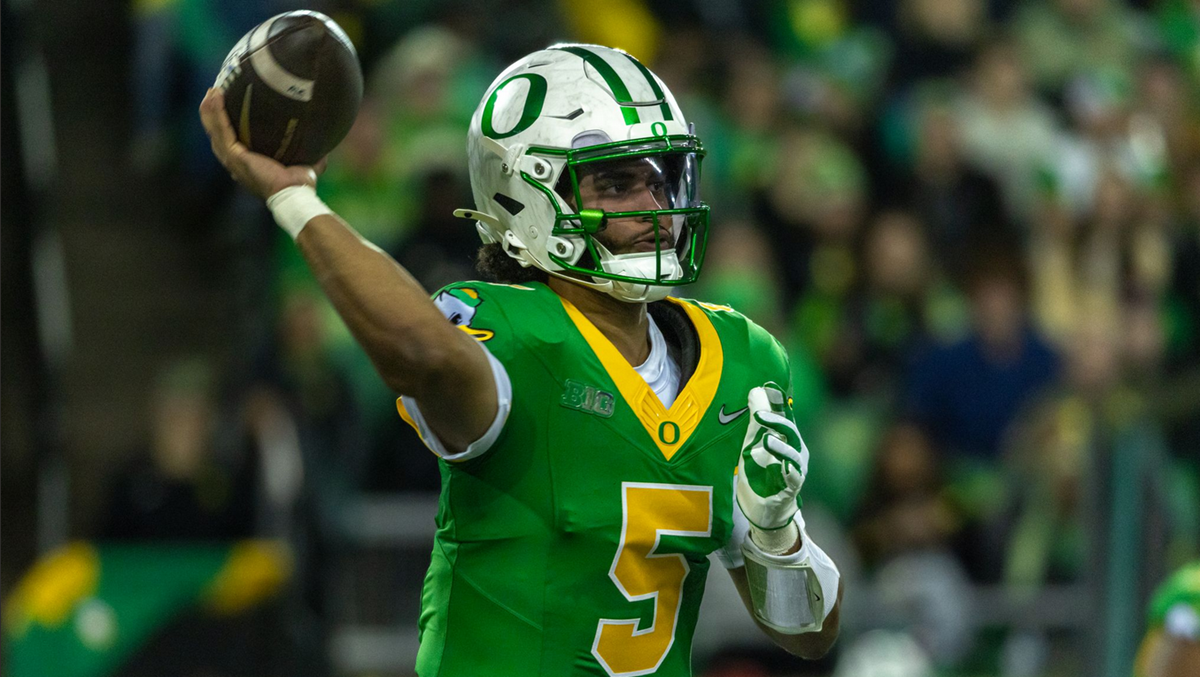
Dante Moore has developed into a stellar passer at Oregon.
(Photo By: Max Unkrich)
But the transfer portal has changed the way recruiting works in another profound way for coaches who are good at using both systems, just as Lanning has proven in the past, making him perhaps the best recruiter in College Football. Lanning has shown he can get the best players out of the portal when he needs them. What this means for high school recruiting is that he gets to be selective about who he chooses. He doesn’t need to fill out a class with three-star prospects to make up the numbers, but instead he will opt for a smaller recruiting class that has better players. In this latest recruiting class, 2026, Oregon only signed 21 recruits.
That does not mean Lanning has not taken on some high school players who are considered to be projects. Linebacker Tobi Haastrup’s first year playing football was his senior year of high school and he is a player who is a development project. He has all the physical tools to be an impact player, but with so little football experience it will take him time to learn the game. He has only appeared in three games this season to preserve his redshirt. Lanning can opt to take the time to develop a player out of high school such as Haastrup because he can turn around and fill the immediate needs via the transfer portal. It is this balance that has enabled Lanning to build a team primed to grow every year, and is probably one of the reasons Oregon loses very few players to the transfer portal.
1. Relentless Recruiting
Former Oregon offensive coordinator Scott Frost was Absolutely Right about Oregon Recruiting in that Oregon did not and continues to not recruit itself (no program does by the way), and Helfrich was actually a good recruiter for Oregon’s old standard. What changed was that Oregon brought in recruiting-focused coaches — first in Willie Taggart, who only penned one recruiting class that was cobbled together last-minute and was a Top 20 class, then Mario Cristobal who revolutionized Oregon recruiting. He worked tirelessly to bring in the best recruits possible to Oregon and brought in the highest-rated recruit in Oregon history in Kayvon Thibodeaux.
Cristobal prioritized recruiting and it paid off, as the best recruiting classes pre-Lanning all came under Cristobal. Kelly did have a few great recruiting classes, but that was because of his revolutionary offensive style became so attractive to some highly-ranked recruits, such as De’Anthony Thomas, who excelled in Kelly’s system.
But what Lanning has done at Oregon has elevated recruiting beyond any fan’s wildest dreams. He just signed one of Oregon’s best recruiting classes in history, ranked No. 3 on Rivals, where Oregon signed a program record of five five-star recruits. Lanning and company rarely give up on a recruit and more often than not it pays dividends, even if it’s years later.
Bonus! Winning.
There is one thing the Ducks have been doing for the last 20 years, and that’s winning games. At the end of the day that is going to be the biggest recruiter for any prospect. Playing for a winning team and a winning coach can launch a player into the NFL ,which is the end goal for all top athletes, and all of Oregon’s coaches since 2000 have shown they can do that.
National Signing Day is over and the portal doesn’t open until January, but there is still work to be done on the recruiting front, and that includes beating James Madison University on December 20th at Autzen. What better recruiting tool could there be?
David Marsh
Portland, Oregon
Top Photo By Scott Kelley

Natalie Liebhaber, the FishDuck.com Volunteer Editor for this article, works in financial technology in SLC, Utah.
Share your thoughts about this team in the only free, “polite and respectful” Oregon Sports message board, the Our Beloved Ducks forum!
Related Articles:
Will Ducks QB Akili Smith Jr. Find Opening in a Crowded Room?
College Football - It's Past Time to Fix the Calendar
The Fair Catch Kick: A Bizarre Rule Change for Lanning to Exploit?
How the Big-10 Football Schedule Can Become Fair
Oregon’s Most Iconic Games in Ducks Football History
Will a 24-Team Playoff Field Ruin College Football?

David Marsh is a high school social studies teacher in Portland, Oregon. As a teacher he is known for telling puns to his students who sometimes laugh out of sympathy, and being both eccentric about history and the Ducks.
David graduated from the University of Oregon in 2012 with Majors in: Medieval Studies, Religious Studies, and Geography. David began following Ducks Football after being in a car accident in 2012; finding football something new and exciting to learn about during this difficult time in his life. Now, he cannot see life without Oregon football.