
We are in the second year of the 12-team playoff, and still the playoff formula hasn’t changed from the BCS era. The formula is simple: play your schedule and don’t lose. Sounds simple, right? Just win out and you’re in, and the best teams should win out. In theory that makes sense, but the reality is that not all schedules are created equal, and the teams with easier schedules rise to the top of this format — except it doesn’t always work that way.
Even our Mr. FishDuck is frustrated, as he took a break from his study of the betting odds on the games according to BOYLE Sports to vent his frustration over goalposts moving again for determining Playoff participants.
Texas A&M is Mediocre
Texas A&M was exposed badly by Texas this weekend. Texas A&M was a 11-0 team and ranked No. 3 in the College Football Playoff Rankings. The Aggies played a schedule where their opponents’ combined record was 58-74, and this is an SEC schedule. Many of those teams had FCS opponents late in their schedule, which inflates their win total, including Texas A&M which took on Samford (1-11) in the second-to-last week of the season.
In their final game of the season they were exposed for the mediocre frauds they were in their 10-point loss to 9-3 Texas. The best win of Texas A&M goes to their one-point win over No. 9 Notre Dame, who also has a highly problematic schedule in terms of its ease, with the likes of Purdue, Arkansas, Boise State, Syracuse and Stanford to make up the bottom half of their schedule.
Does this mean that 9-3 Texas is worthy of a College Football Playoff berth? Absolutely not; they got blown out by Georgia and lost to Florida. And sure, they lost to Ohio State in their opening game, which would be a “quality loss” — but that third loss to a 4-8 Florida sinks them. They didn’t take care of business either.
Scheduling Woes
Programs don’t have much say in their conference scheduling but they do have control of their out of conference schedules but those are planned years, almost decades in advance, and sometimes these schedules can be changed quickly but that is quite rare.
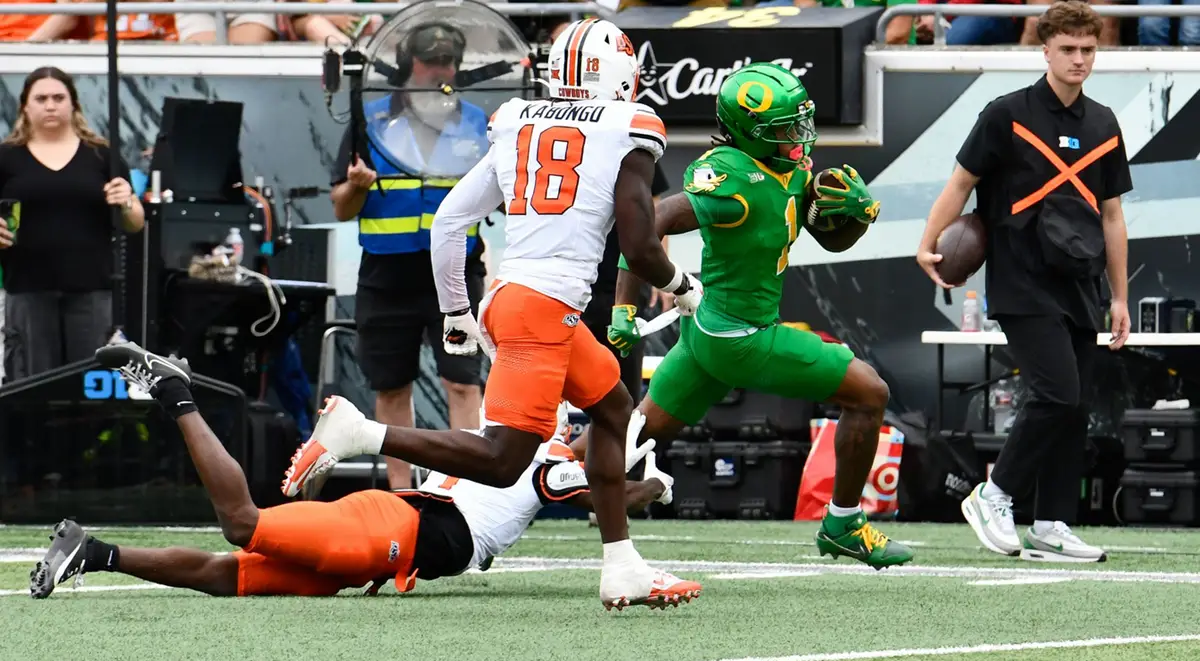
Dakorien Moore scores against Oklahoma State, a team that should have been a better out-of-conference opponent.
(Photo By: Scott Kelley)
Let’s take a look at Oregon’s out-of-conference schedule for this season. Most programs want to schedule an FCS, Group of Six (putting the Pac-12 in this), and a Power Four opponent. This is pretty standard fare, and there is a bit of a push for the B1G and SEC to change the Power Four opponent to a Power 2, namely the B1G and SEC crossover games — but that is likely years away from happening.
By this standard, Oregon’s out-of-conference schedule is in theory pretty good.
Oregon played a top-tier FCS opponent in Montana State, the No. 2 seed in the FCS playoff, and Oregon destroyed them because a Top-10 FBS team should destroy a Top-10 FCS team. Next up the Ducks played a Power Four opponent in Oklahoma State, who has been a good team over the past 10 years when this game was scheduled — but Oklahoma State is absolutely dreadful this year; so bad that they fired their longtime head coach a week later. Then for the Group of Six team, the Ducks scheduled instate “rival” Oregon State and they too were demolished.
Most pundits would call this a weak out-of-conference schedule, and it was, but it wasn’t inherently going to be that bad on paper when it was made it just turned out that way.
The same goes for a good chunk of Oregon’s, and likewise Ohio State and Indiana’s conference schedules. In Week 5, Oregon had a marquee game against Penn State, and it was considered a great win in the immediate aftermath. However, Penn State was broken by Oregon’s win and went on to lose to UCLA and Northwestern, and the losing just kept on coming until November 15th when they won their first conference game against Michigan State. Penn State went from a Top-10 team and a near lock for the playoff to another team without a head coach adrift in the 2025 college football season.
Other teams on Oregon’s schedule this year don’t help the Ducks’ case for a strong schedule either, with some of the Ducks’ best wins being USC, Washington, Minnesota and Iowa.
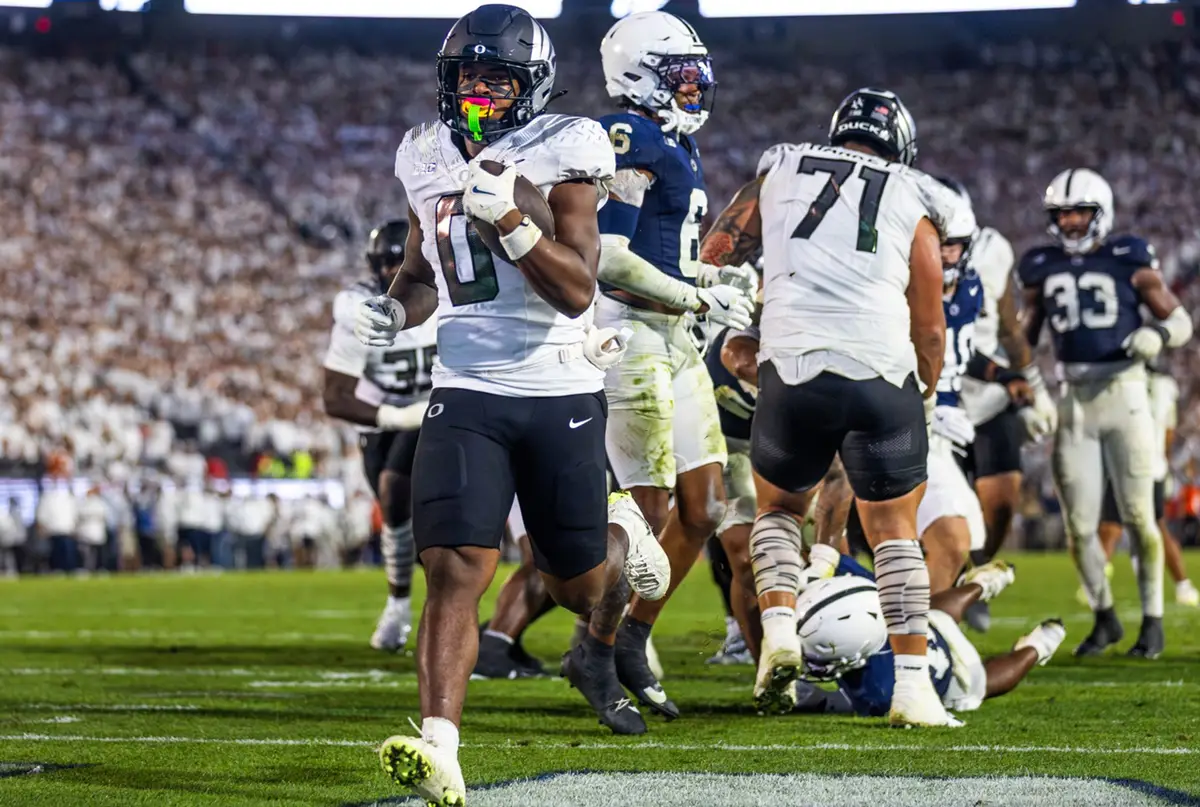
Davison scores against Penn State in a big win that didn’t age as well as it should’ve.
(Photo By: Max Unkrich)
But at the end of the day Oregon, like any other team, has to play their schedule. They don’t have any options to change it mid-season, and as a result, they do the only thing they can do: take care of business. Oregon has done that every week since their mid-season loss to Indiana.
This also applies to Texas A&M here. Sure, their schedule was weak, but that was the schedule they got and it wasn’t their fault that Arkansas, LSU and South Carolina are awful. It was their fault for scheduling Samford, which was weak, but they played their schedule. But they also needed to take care of business against Texas and they failed. The committee will get to decide where to place Texas A&M in their final rankings, because losses at the end of the season should hold more weight than losses early in the year.
So even as we enter the second year of the 12-team playoff, nothing has really changed in how the slate of teams is selected. It’s selected by humans who watch some of the games but certainly not all of them, and they select teams in the Top 25 not based on the merit of who they play, but on their record and brand. If Texas A&M was in the Mountain West, like Boise State last year, they would not have been ranked No. 3 at any point this season, but because they play in the SEC and had a weak schedule their wins counted for more — until they lost.
So the formula hasn’t changed; just win and try to look good while doing it. It isn’t the fairest system, but it will probably produce the best group of candidates for the playoff with the current systems we have in place. For now, Oregon is in and they just need to prove they belong by winning in December and January.
David Marsh
Portland, Oregon
Top Photo By Max Unkrich

Natalie Liebhaber, the FishDuck.com Volunteer Editor for this article, works in financial technology in SLC, Utah.
Share your thoughts about this team in the only free, “polite and respectful” Oregon Sports message board, the Our Beloved Ducks forum!
Related Articles:
Unbelievable...Same SEC Stuff, Different Day
Why Oregon Football Always Belongs in the National Conversation
The B1G Won the 2026 Coaching Carousel...Big-Time!
Continuity? Lanning's Hiring Success is Put to the Test
Why Whether Dyer Was Down or Not...Doesn't Matter
How to Analyze Football Talent Like a Pro

David Marsh is a high school social studies teacher in Portland, Oregon. As a teacher he is known for telling puns to his students who sometimes laugh out of sympathy, and being both eccentric about history and the Ducks.
David graduated from the University of Oregon in 2012 with Majors in: Medieval Studies, Religious Studies, and Geography. David began following Ducks Football after being in a car accident in 2012; finding football something new and exciting to learn about during this difficult time in his life. Now, he cannot see life without Oregon football.