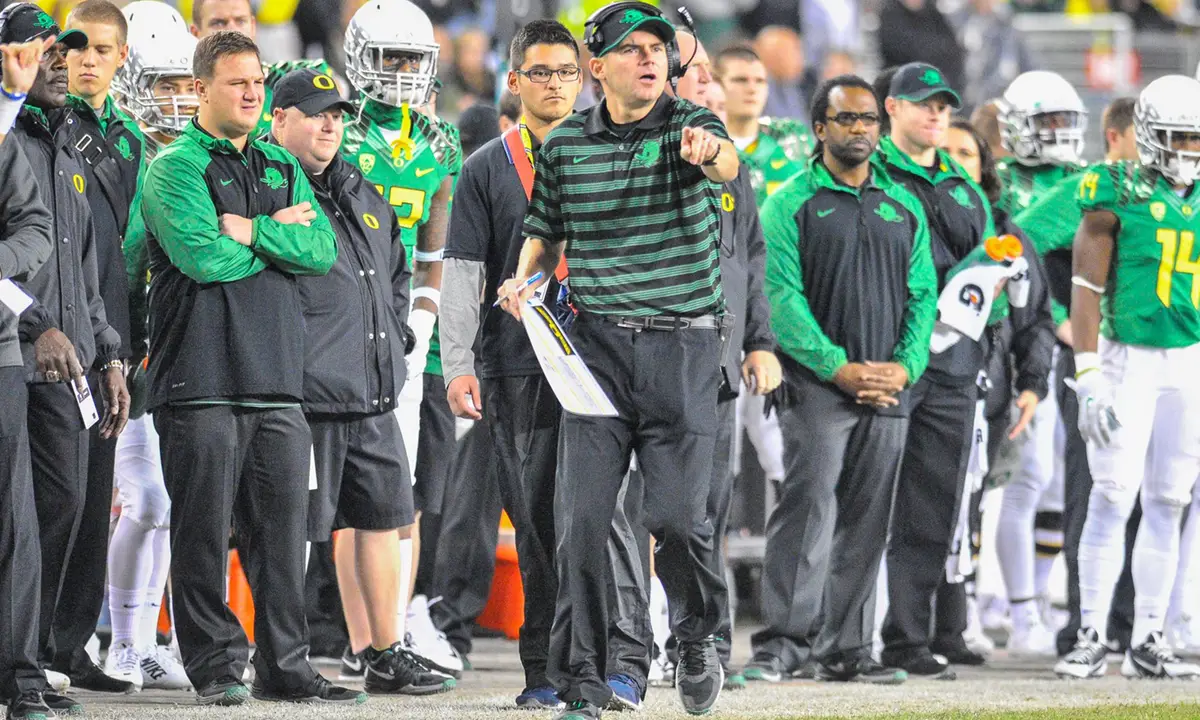
Former HC Mark Helfrich doesn’t get much love from a great portion of the Oregon fan base. He was the last of the decades-long tradition of continuity at Oregon, and in 2014 he was the man in charge when Oregon reached its peak (though we all hope to see Dan Lanning surpass that mark soon). In 2014 the Ducks won the conference, won the Rose Bowl (and the first playoff game), competed in the National Championship, and Marcus Mariota won the Heisman Trophy.
Our own Mr. FishDuck was writing articles, and publishing through that span at FishDuck, and he took time from his fun at Fanduel and his study at Ncaaf latest news to share some spirited opinions about the trials and victories over that four years.
The Ducks in Helfrich’s four years as head coach went 36-16 or 69%, which is an incredible win rate for any coach outside of the absolute top tier. By comparison, Mike Bellotti went 116-55 (67%) and Rich Brooks went 91-109, though Brooks was the foundation for the modern Oregon program and his first several seasons were a complete rebuild.
If Helfrich’s tenure had come after either of those coaches, he probably would have held onto his head coaching job for a lot longer. However, he followed Chip Kelly who caught lightning in a bottle going 46-7 for an 87% win rate. Following in Kelly’s shadow was the most difficult expectation for Helfrich to meet.
Reviewing the Record 2013-2015
In 2013 the Ducks went 11-2, with losses to Stanford and Arizona. 2013 was also the year that a late hit from UCLA partially tore Mariota’s MCL, which resulted in his inability to be a running threat for the remainder of the season. This revealed a major problem in the program; the Ducks didn’t have a backup quarterback, as an injured Mariota was preferable. Though the season was still largely seen as a success with a win over Texas in the Alamo Bowl, it was certainly a great “what if” season where if Mariota was not injured the season could have gone a completely different way.
2014 was the high water mark with 13-2 and a cabinet full of trophies. This season was so good that Helfrich got a contract extension. Duck fans were nervous about the future at quarterback, but with graduate transfer Vernon Adams coming in for 2015, the future seemed bright.
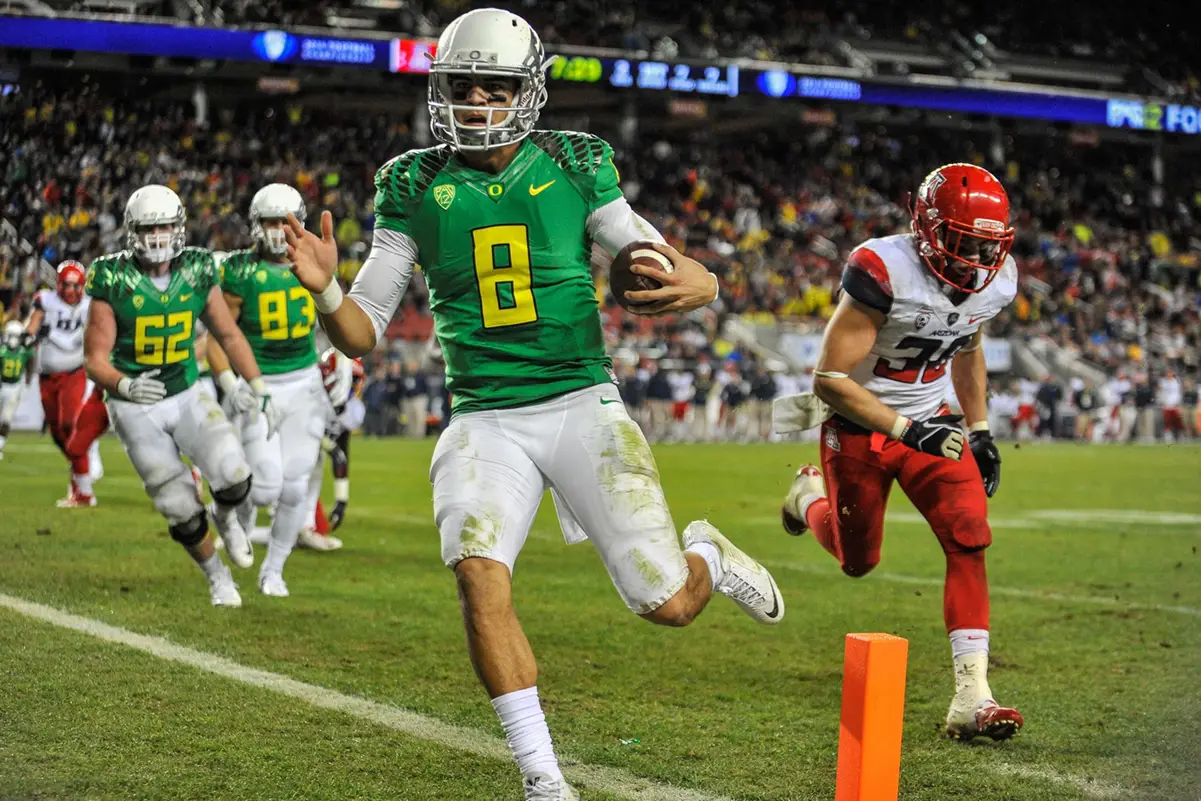
Mariota scores against Arizona in the 2014 Pac-12 Championship Game.
(Photo by: Kevin Cline)
But 2015 wasn’t as bright of a season as it could have been, as Adams’ finger was broken in the opening game. What might have transpired if this hadn’t happened can be seen in one of my earlier articles. The defense fell apart and was, at the time, the worst defense in Oregon history. It all culminated in a disaster at the Alamo Bowl where Adams was injured along with the starting center right before halftime. The defense, which pitched a shutout in the first half, completely collapsed in the second half, giving up more than 30 points.
How 2015 ended is what truly marked the beginning of the end of the Helfrich era. Jeff Lockie and Taylor Alie were both incapable of running the offense at a high level when called to do so throughout the season.
And while the Doug Brenner gets a lot of heat for his poor snapping in the Alamo Bowl, the reality was that he was the third-string center. The actual backup center was freshman Jake Hansen, who became the starter the following year. The coaching staff did not feel it was worth burning his redshirt for the second half of a bowl game. This was the right choice from a roster management perspective, though watching our Ducks fall apart was painful.
Roster Depth and Recruiting
Through his first three season at Oregon, Helfrich amassed a record of 33-9 or an 80% win rate. Oregon lacked depth at multiple positions and that was the Ducks’ undoing in all three seasons. All three seasons lacked a suitable backup quarterback, and 2014 fell apart at the National Championship game largely because the mountain of injuries was simply too much to overcome against an opponent who was already a physical mismatch.
This depth problem was something that had always been with Oregon, and those special seasons had always come down to luck concerning injuries. Part of Oregon’s depth problem stemmed from recruiting. Oregon was not the recruiting juggernaut it is today and was largely dependent on finding three stars that fit the schematic profile for the offense and defense, and then developing them into stars.
Sometimes Oregon fans paint a far too rosy picture of Kelly’s recruiting prowess during his time as head coach, and though his offense brought a new spark to Oregon’s recruiting, he wasn’t that far from the Oregon average. Helfrich had to deal with sanctions that stemmed from the Kelly era, and Oregon still brought in comparable recruiting classes on paper. The reality, though, was Helfrich suffered a lot of high-profile misses. Who can forget Canton Kaumatule, Taj Griffin and Morgan Mahalak?
But they did bring in Justin Herbert, Charles Nelson, Royce Freeman, Tyrell Crosby and so many other big names in Oregon’s history.
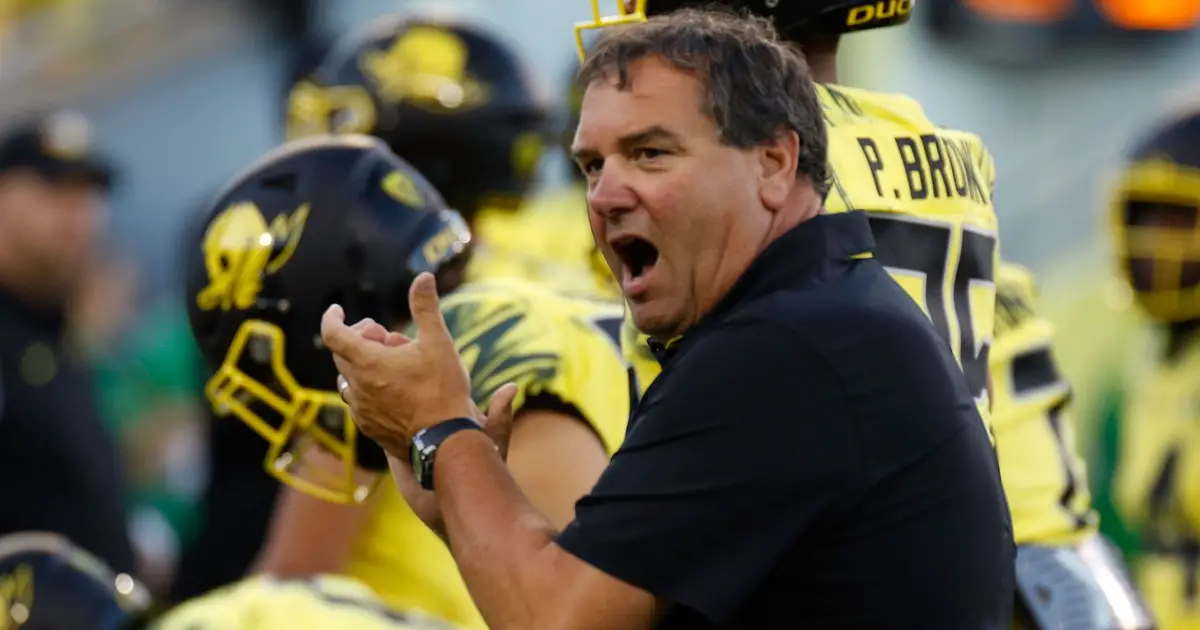
Brady Hoke was the wrong hire for defensive coordinator for Oregon.
(Photo By: Gary Breedlove)
Defensive Coordinator Problems
2013 was long-tenured DC Nick Aliotti’s final season coaching. He did a fantastic job adapting his aggressive scheme to work in tandem with Kelly’s high-powered offense. Aliotti was passed over for the head coaching job after Kelly left for the NFL in favor of Helfrich. The thought process was to keep the offensive focus of the program intact and continue a line of head coaching hires by promoting the offensive coordinator. This was the case for Bellotti, Kelly and Helfrich, and later Mario Cristobal would continue this trend. Promoting from within was the Oregon way.
In 2014 Helfrich needed to hire a new defensive coordinator for the program. He opted to promote linebackers’ coach, and long-tenured staff member, Don Pellum to the position of DC. This was continuing the Oregon way, to promote from within and to look at Pellum’s promotion in this light makes a lot of sense.
In the 2014 season many of the defensive woes were covered up by veteran players, but with the departure of those upperclassmen, things fell apart in 2015. This prompted Helfrich to demote Pellum and hire a new defensive coordinator from outside the program. For 2016, Brady Hoke, former Michigan Head Coach, took over the job of DC for the Oregon Ducks. Hoke came to Oregon having never been a defensive coordinator before, but he had a reputation recruiting well and building defenses.
The Oregon fan base was optimistic and everyone drank the Kool-Aid. Oregon was going to have a good defense.
2016 – The Unraveling
In 2016 Oregon brought in another graduate transfer quarterback in Dakota Prukop. He wasn’t as skilled as Mariota or Adams, but he was serviceable. There was also an up-and-coming freshman by the name of Justin Herbert, an underrated local kid who all the wide receivers were raving about. In the end Prukop won the starting job as his experience was deemed more important than Herbert’s potential.
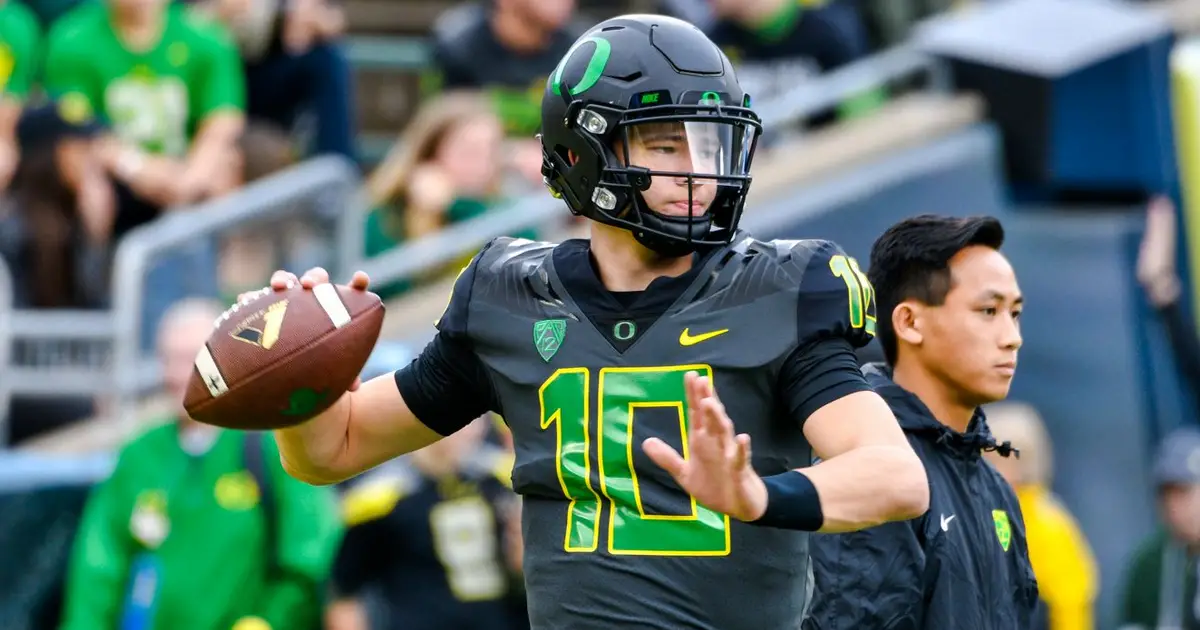
Justin Herbert got his start in 2016. He showed potential when the rest of the team was falling apart around him.
(Photo By: Craig Strobeck)
The look was bad. Oregon had to find another one-year mercenary for quarterback since they had failed to recruit a suitable starter with several four-star recruits on the roster. However, Herbert took over half-way through the season and was deemed to be the future quarterback of the program, so it was worth getting him game experience.
But if the look at quarterback wasn’t great, the defense was without a doubt a complete train wreck. The defense gave up a whopping 41 points per game. The offense only averaged 35 points per game but that number needs to be taken with a grain of salt, as the offense was largely not bad — it just never had the football.
The 2016 season ended with the Ducks winning only four games. The last time Oregon had a losing record was 2004. It was a complete disaster and it would spell the end of Helfrich.
The Bright Spots
The 2016 season itself was awful — there is no way around that — but the Ducks were also a rather young team with players on the roster who went on to become household names. Troy Dye made his mark this season, leading the team in tackles his freshman year. The offensive line was composed almost entirely of redshirt freshmen including Hanson, Shane Lemieux and Brady Aiello who all became major contributors in the Willie Taggart and Cristobal Eras. The defense saw Ugo Amadi and Arrion Springs take major leaps in their development as well.
We believed our Ducks would just reload from year to year and not need a rebuild, but 2016 was a rebuild in more ways than one. Helfrich is often maligned for poor recruiting, but he really wasn’t outside the Oregon norm.
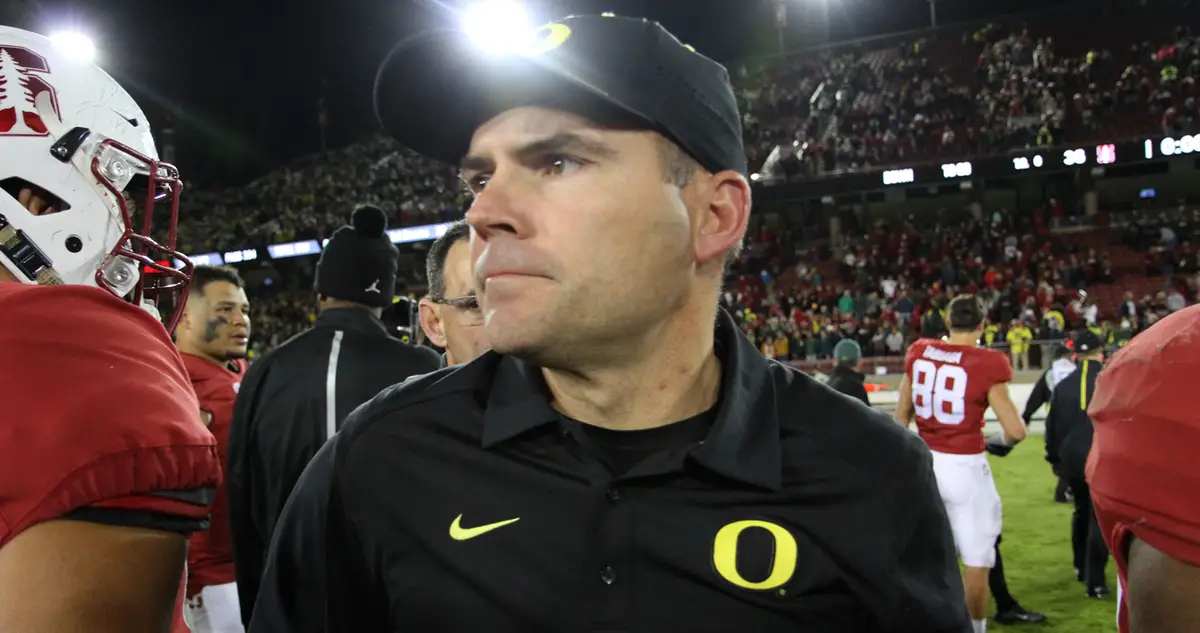
Mark Helfrich after a major win over Stanford in 2015 where Stanford lost their shot at the CFP.
(Photo By: John Sperry)
The reality is there were problems within the program that ran deeper than any fan truly understood at the time. College football was changing, though many of the major changes we think about today were only in their infancy. But what was clear was Helfrich and this old veteran staff weren’t up to the task of building Oregon to the next level. Defenses had caught up with Oregon’s offensive revolution and Oregon’s selective and non-social media oriented recruiting process was simply outdated.
If Helfrich was given another year or two, he probably would have gotten Oregon more or less back on track, but his days were numbered. But there is something admirable about the man who pleaded with Kelly to return to Oregon as the head coach so the veteran staff could remain intact. He was a man of Oregon through and through, and he was the last of a long line of Oregon continuity.
Strangely enough, Lanning feels more in the mold of these old veteran staffs, though he certainly has more charm than Kelly and Helfrich combined while still doing a good job of telling the media absolutely nothing.
How do you remember Mark Helfrich and his years at Oregon?
David Marsh
Portland, Oregon
Top Photo By: Kevin Cline

Natalie Liebhaber, the FishDuck.com Volunteer Editor for this article, works in technology in SLC, Utah.
Share your thoughts about this team in the only free, “polite and respectful” Oregon Sports message board, the Our Beloved Ducks forum!
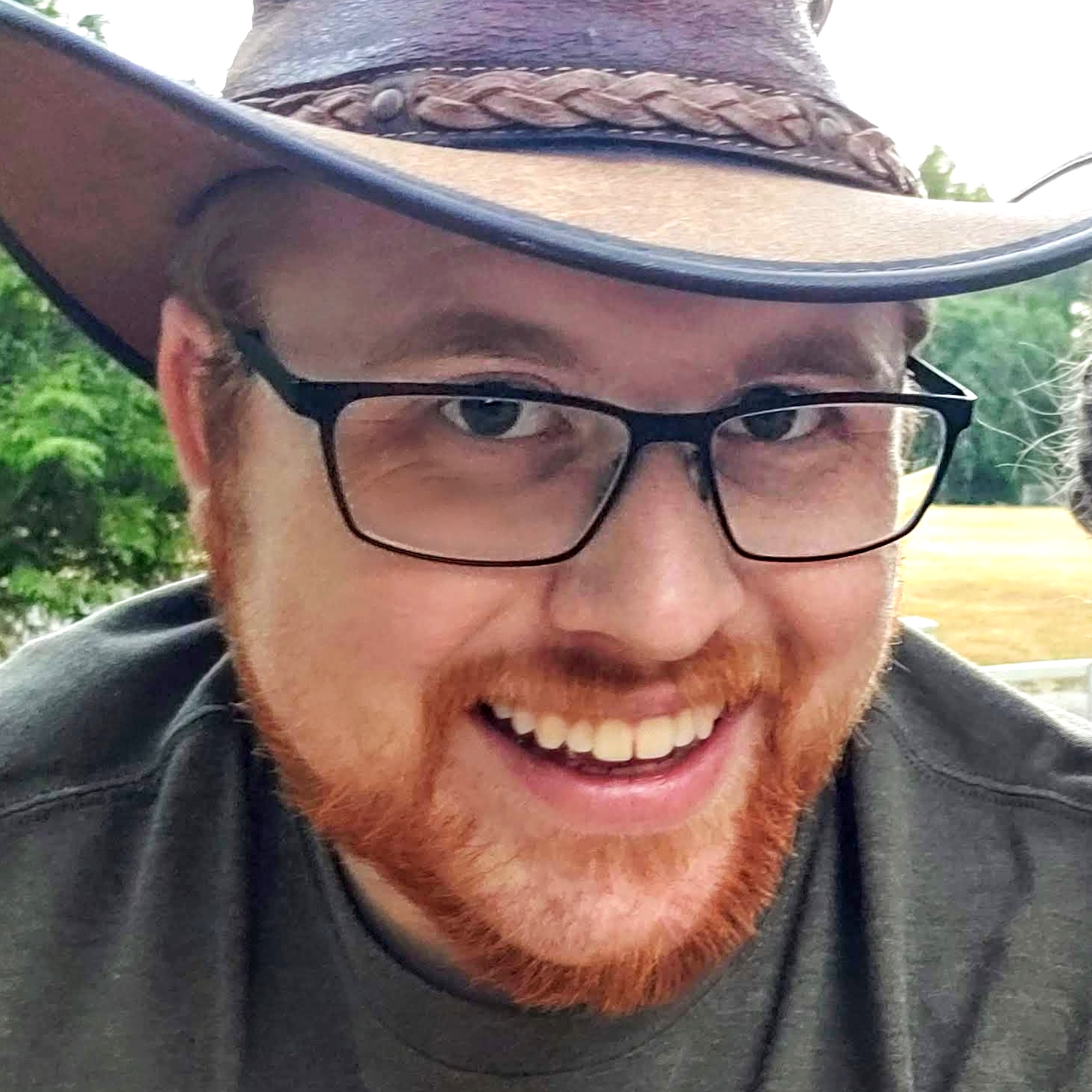
David Marsh is a high school social studies teacher in Portland, Oregon. As a teacher he is known for telling puns to his students who sometimes laugh out of sympathy, and being both eccentric about history and the Ducks.
David graduated from the University of Oregon in 2012 with Majors in: Medieval Studies, Religious Studies, and Geography. David began following Ducks Football after being in a car accident in 2012; finding football something new and exciting to learn about during this difficult time in his life. Now, he cannot see life without Oregon football.