

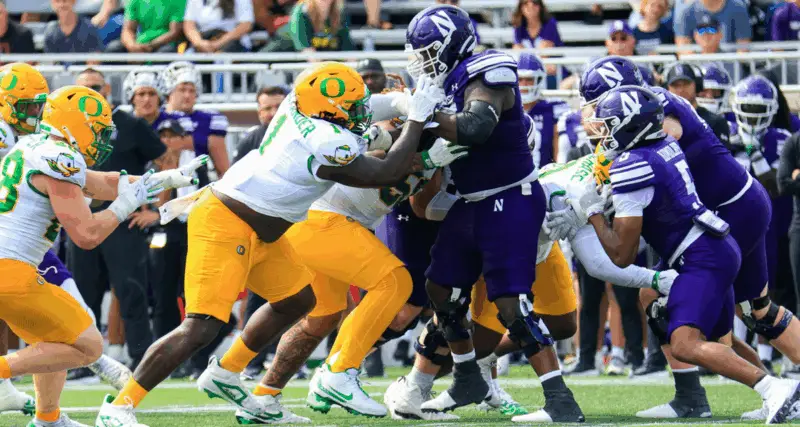
For two weeks in a row the Oregon defense has been exposed, though the final scoreboard may not show it. The Duck defense has a weakness in defending the run.
Against Oklahoma State the Ducks gave up 144 total yards, which may not sound too bad as the bulk of Cowboys’ total offense came off only a few drives — but on those drives, the Ducks found themselves pushed back on long, grinding drives that ate clock and kept the defense on the field. That’s the very thing the Ducks don’t want. Mr. FishDuck agrees, and took a break from his study of outstanding paper writer services to express his frustration to me.
Then this weekend against Northwestern, the Ducks gave up a total of 178 yards on the ground. This number is misleading on two accounts. One, in college football, sacks count as negative rushing yards and the Oregon defense had two sacks and two tackles for loss, plus the big drop by the Northwestern quarterback that was negative 18 yards. The reality is that the Ducks gave up closer to 200 yards on the ground. These yards sustained Northwestern drives throughout the game.
The other piece of this stat that needs to be accounted for is that 79 yards of rushing came from Northwestern on a single play at the end of the fourth quarter against Oregon’s backups. It is worth mentioning that Oregon intends to rely heavily on its backups as the year progresses, and them giving up a major explosive play is telling to some of the team’s issues.
So what can be done?
Dan Lanning and company are already addressing this problem. Moving starting safety Dillon Thieneman up closer to the line of scrimmage does give more run-stopping potential as he becomes a hybrid safety and linebacker.
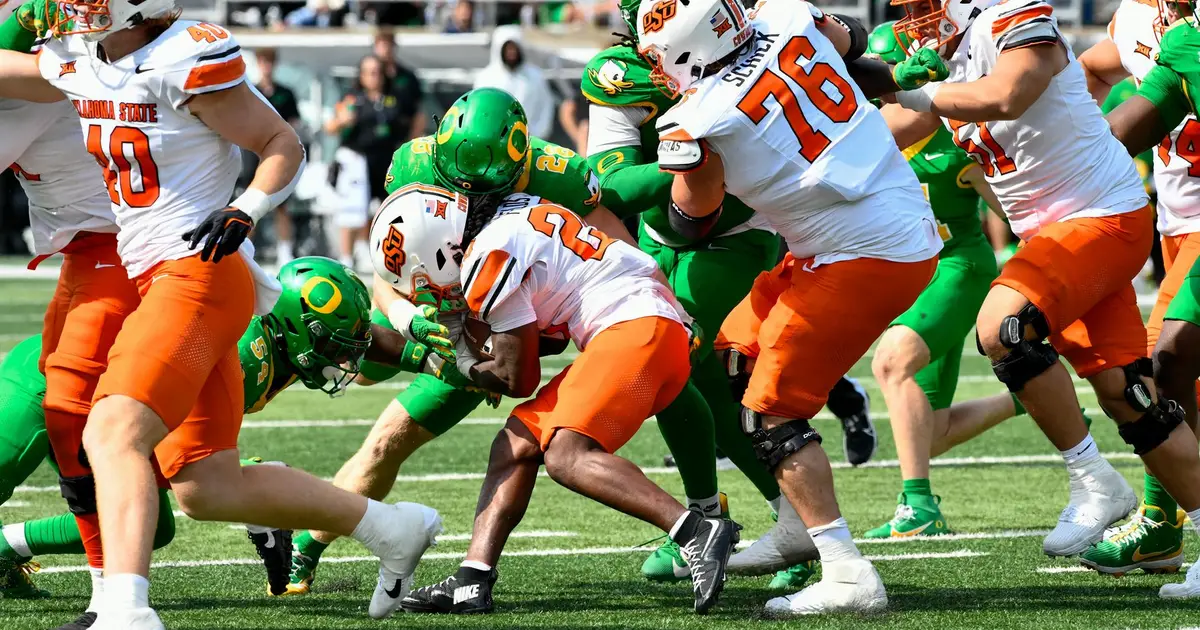
Oregon struggled at times to stop Oklahoma State from running the football.
(Photo By: Scott Kelley)
Tackling hasn’t been bad, as missed tackles haven’t plagued this team to date; however, the defense is giving up significant yards after contact. Northwestern’s runners all seemed to have a habit of falling forward and getting a push from behind from their linemen, turning a two-yard run into five. So ensuring better tackling and stopping the run at contact is a point I’m sure coaches will be emphasizing this week.
Oregon’s coaches will also be working with defenders to ensure they get better push at the line of scrimmage. At times, the defensive line just looked sluggish and got stuck on blocks, opening up running lanes for Northwestern’s runners.
Oregon has the talent and going 3-0 out of the gate this year is a great start. They have Oregon State at home next week to get right before traveling to Penn State in Week 5. The Ducks will need to stop the run against the Nittany Lions if they hope to leave Beaver Stadium with a win. Last year Penn State ran for 297 yards in the B1G Championship Game, turning the game into a shootout.
That is not a reliable winning recipe for the Ducks this year, especially since Jim Knowles, former Ohio State defensive coordinator, is now Penn State’s defensive coordinator and knows how to slow and stop the Oregon offense. So it will be on the defense to get stops against the Penn State offense, and that will require getting stops against the run.
The win over Northwestern was a decent first road test this year, but the Ducks have greater aspirations and the D is going to need to put together a more imposing run defense to achieve those goals.
David Marsh
Portland, Oregon
Top Photo By Brad Repplinger

Natalie Liebhaber, the FishDuck.com Volunteer Editor for this article, works in technology in SLC, Utah.
Share your thoughts about this team in the only free, “polite and respectful” Oregon Sports message board, the Our Beloved Ducks forum!
Related Articles:
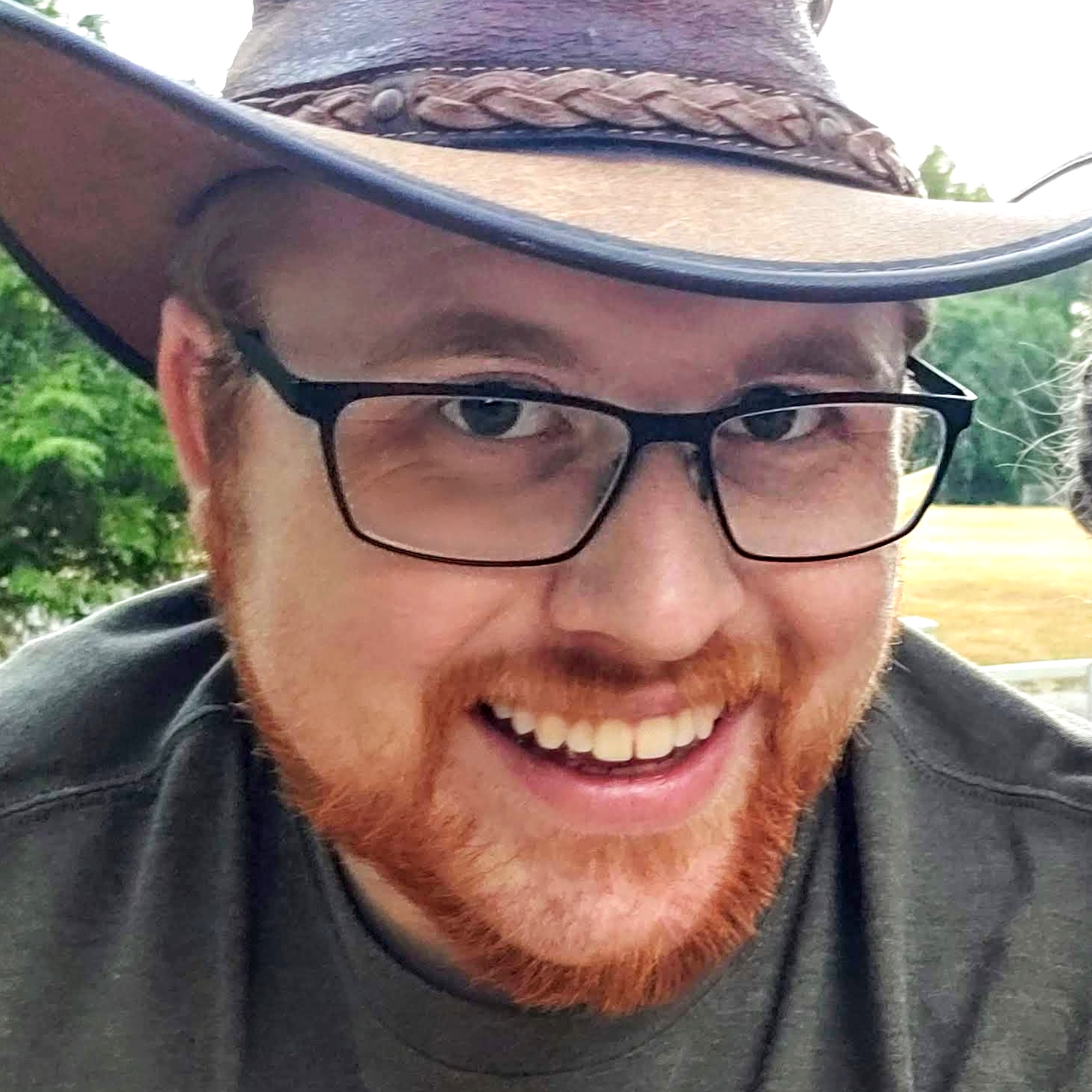
David Marsh is a high school social studies teacher in Portland, Oregon. As a teacher he is known for telling puns to his students who sometimes laugh out of sympathy, and being both eccentric about history and the Ducks.
David graduated from the University of Oregon in 2012 with Majors in: Medieval Studies, Religious Studies, and Geography. David began following Ducks Football after being in a car accident in 2012; finding football something new and exciting to learn about during this difficult time in his life. Now, he cannot see life without Oregon football.